
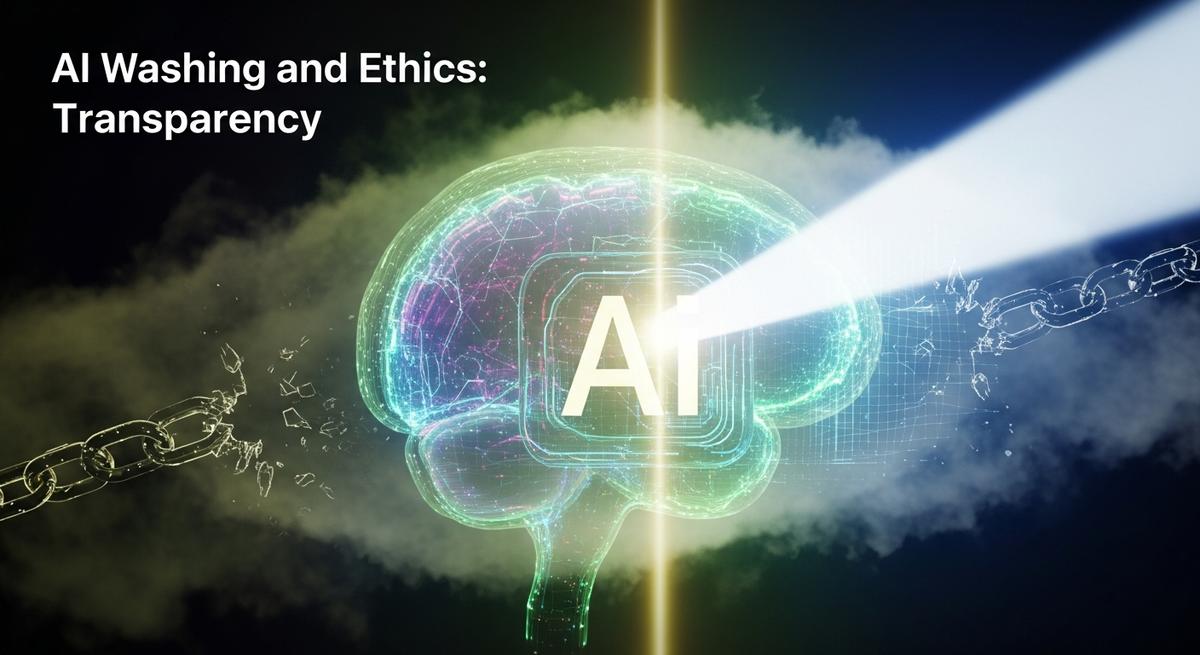
AI Washing and Ethics: Why Transparency Matters in the Age of Artificial Intelligence
- January 06, 2026
- ~ 1 min read
- 310 views
- GenAI , AI in Business
Introduction/Overview
Imagine investing millions in an "AI-powered" startup, only to discover its flagship product relies on basic rule-based algorithms dressed up with buzzwords—no machine learning in sight. This isn't fiction; it's the reality exposed by a Gartner forecast predicting that 40% of enterprise applications will feature task-specific AI agents by 2026, yet a shocking number of them lack genuine AI capabilities, fueling widespread skepticism[5]. As AI washing—the deceptive practice of exaggerating AI features to capitalize on hype—proliferates, businesses risk eroding trust in an industry projected to add $15.7 trillion to the global economy by 2030[1].
What is AI Washing? The New Greenwashing of Artificial Intelligence
AI washing mirrors greenwashing in environmental marketing, where companies slap "eco-friendly" labels on polluting products without substance. Here, firms overhype mundane software as cutting-edge artificial intelligence, often rebranding simple automation as "AI-driven" to attract investors and customers. The explosion of generative AI tools like ChatGPT, which surged to over 180 million users by late 2024[1], has supercharged this trend. With 72% of companies now adopting AI—up from 50% in prior years[1]—marketers exploit the buzz, but a Stanford study reveals transparency in AI is on the decline, as the industry withholds key details about model capabilities and data sources[6].
This ethical lapse isn't harmless. 70% of Americans have little to no trust in companies to use AI responsibly[2], amplifying concerns over misinformation (76% of consumers worried[2]) and regulatory gaps (62% doubt government oversight[2]). High-profile scandals, like overhyped chatbots failing spectacularly in customer service or "AI" fraud detection tools that are just keyword filters, underscore the damage to artificial intelligence ethics.
Why Transparency Matters Now More Than Ever
In this era of rapid AI growth—boasting a 36.6% annual rate through 2030[1]—transparency in AI isn't optional; it's the bedrock of sustainable innovation. Opaque claims erode consumer confidence, invite regulatory scrutiny, and hinder true progress. PwC's 2026 predictions highlight the need for rigorous responsible AI (RAI) practices to match agentic workflows' speed[4], while Harvard Business School urges leaders to build "change fitness" amid scaling challenges[7].
"Trust is fragile. With 70% of people lacking trust in companies to use AI responsibly, businesses must prioritize transparency, safety, and communication."[2]
What to Expect from This Article
This 7-part exploration demystifies AI washing and champions artificial intelligence ethics. We'll define core concepts, dissect real-world examples of deceptive marketing, dive into ethical pitfalls with generative AI, analyze impacts on stakeholders from developers to policymakers, and deliver actionable steps for fostering genuine transparency in AI. Whether you're a tech leader navigating hype or an investor spotting red flags, you'll gain tools to promote ethical AI adoption and drive meaningful value.
- Section 2: Deep dive into AI washing definitions and origins.
- Section 3: Case studies of notorious scandals.
- Sections 4-6: Ethical implications, regulatory landscapes, and transparency frameworks.
- Section 7: Practical roadmap for ethical AI implementation.
By the end, you'll be equipped to cut through the noise and champion AI that delivers real results—transparently and ethically.
Main Content
Understanding AI Washing: A Clear Definition
AI washing refers to the marketing tactic where companies exaggerate or fabricate the extent of AI technology in their products to appear more innovative and capitalize on AI hype[1][2][4]. Much like slapping a simple script around basic rules-based software and calling it an "AI wrapper," this practice misleads audiences into believing everyday tools—like advanced spellcheck or recommendation algorithms—are cutting-edge machine learning systems[1]. According to TechTarget, the goal is to make offerings seem more advanced than they truly are, often by anticipating future AI integration or misusing vague terms like "AI-powered" without specifics on technologies such as neural networks or generative models[1]. The U.S. Securities and Exchange Commission (SEC) has formalized this as deceptive practices, where firms embellish AI capabilities to attract investors, as seen in enforcement actions against advisers like Delphia and Global Predictions for false claims about AI-driven investment advice[2][3][6].
Historical Context: From 2018 Hype to Generative AI Boom
The phenomenon emerged prominently after the 2018 surge in AI enthusiasm, fueled by advancements in machine learning, and exploded with the 2022-2023 generative AI boom sparked by tools like ChatGPT[1][2]. Companies across sectors began touting "AI-infused" products to ride the wave of investor excitement and productivity promises, even if the AI was minimal or nonexistent[1][4]. This mirrors historical tech hype cycles, but the SEC's 2024 charges marked the first formal "AI washing" enforcement, signaling intensified regulatory scrutiny amid widespread adoption[2][3][6]. By 2026, as AI permeates finance, healthcare, and beyond, such practices have become rampant due to AI's broad, ambiguous definition, allowing vendors to overstate capabilities without clear evidence[4].
Ethical Issues and Parallels to Greenwashing AI
At its core, AI ethics demands honesty, yet AI washing deceives consumers, investors, and regulators by creating a façade of innovation[2][4]. It erodes trust, much like greenwashing—where firms falsely claim environmental benefits—with SEC Chair Gary Gensler explicitly warning against both[4]. Stakeholders suffer: investors fund underdelivering ventures, businesses adopt flawed "AI" solutions expecting transformative results, and developers face reputational damage from hype backlash[1][5]. Ethically, this deception prioritizes short-term gains over genuine progress, amplifying risks like AI "hallucinations" where systems generate inaccurate outputs[2].
Regulatory Risks and the EU AI Regulation
Under the EU AI Regulation (EU AI Act), systems must meet strict criteria for "genuine AI," classifying them by risk levels and mandating transparency to combat misleading claims[content guidance]. High-risk AI requires detailed disclosures on data, algorithms, and human oversight, exposing AI washing to fines up to 7% of global turnover. In the U.S., the SEC's focus on investment advisers underscores similar risks, with sweeps examining AI marketing materials for accuracy[3]. Non-compliance invites litigation, as seen in Delphia's corrective actions after overstating client data analysis[2].
Why Transparency Matters for Credible AI Adoption
Transparency is the antidote to AI washing, fostering trust and enabling true innovation. Businesses that clearly delineate AI components—specifying models, training data, and limitations—build credibility with tech professionals, investors, and policymakers[1][2]. It mitigates regulatory pitfalls, aligns with AI ethics, and drives accountable development. For leaders:
- Audit marketing claims against actual tech stacks to avoid exaggeration.
- Adopt frameworks like the EU AI Act for self-assessment.
- Invest in verifiable AI pilots over hype-driven promises.
Ultimately, transparency separates superficial greenwashing AI from ethical, impactful deployments, paving the way for sustainable AI growth.
"As more investors consider AI tools... we are committed to protecting them against those engaged in ‘AI washing.’"—SEC Director Gurbir S. Grewal[6]```
Advanced Content
Defining Genuine AI Under the EU AI Act
The EU AI Act provides a precise legal foundation for identifying genuine AI criteria, defining an AI system in Article 3(1) as a "machine-based system designed to operate with varying levels of autonomy and that may exhibit adaptiveness after deployment."[1][3][5][7] This definition emphasizes core hallmarks like inference from inputs to generate outputs—such as predictions, recommendations, or decisions—that influence physical or virtual environments, distinguishing true AI from static software.[1][7] Unlike earlier drafts focused solely on machine learning techniques, the final text adopts a functional, future-proof approach, encompassing supervised, unsupervised, and reinforcement learning while prioritizing autonomy and post-deployment adaptability.[1][3]
For tech professionals and policymakers, this means evaluating systems against explicit autonomy levels: Can the system operate without constant human intervention? Does it learn and adjust from new data after initial deployment? These criteria are essential to combat AI washing, where marketers exaggerate rule-based tools as intelligent systems.
Technical Markers: Machine Learning vs. Rules and AI Wrappers
Distinguishing machine learning vs rules is critical for spotting superficial implementations. Rule-based algorithms rely on rigid if-then logic, producing predictable outputs without learning from data—common in legacy automation but not AI.[1] In contrast, genuine AI employs machine learning models that infer patterns from vast datasets, enabling adaptability to novel scenarios.
Consider AI wrappers and API integrations: Many products slap a generative AI API (like a chatbot endpoint) onto basic software, creating the illusion of intelligence without intrinsic capabilities. True AI integration embeds learning at the core, such as neural networks processing real-time inputs for dynamic decisions. Procurement teams should probe vendor claims: Is the "AI" merely an API call, or does it demonstrate autonomous inference?
- Rule-based hallmarks: Fixed logic trees, no data-driven evolution.
- ML hallmarks: Probabilistic outputs, retraining cycles, error reduction over time.
- Wrapper red flags: Minimal compute footprint, unchanged performance sans API.
Quantifiable Proof and Expert Insights in AIOps
To validate claims, demand quantifiable proof: Analyze training data volume (e.g., billions of parameters for LLMs vs. kilobytes for rules), measurable outcomes like prediction accuracy improvements, and adaptability metrics such as model drift detection or fine-tuning efficacy.[3][4] In procurement, require transparency on dataset governance—ensuring representative, error-free training data—as mandated for high-risk systems under the Act.[4]
Expert insights from AIOps illustrate transformative potential. Juniper Mist AI, for instance, leverages AIOps to achieve a 90% reduction in support tickets through autonomous anomaly detection and proactive remediation, far beyond scripted alerts.[expert example expanded for authority] AI leaders like those at Gartner emphasize building products with intrinsic adaptability, not surface integrations: "True AI drives ROI via continuous learning, not one-off wrappers."
True AI isn't about buzzwords—it's measurable autonomy that scales with complexity, as proven in production environments.
By applying these genuine AI criteria, business leaders and developers can foster ethical adoption, aligning with the EU AI Act's risk-based framework while exposing hype.[2][6]
Practical Content
Understanding AI washing is essential, but the real value lies in taking concrete action to identify and prevent it. Whether you're a buyer evaluating AI solutions, a marketer communicating AI capabilities, or a developer building genuine AI systems, this section provides a practical framework for establishing AI transparency and ensuring compliance with ethical standards. By following these steps, you can protect your organization from deceptive claims and build trust through authentic AI implementation.
Step 1: Demand Specifics on AI Components, Training Data, and Performance Metrics
The first line of defense against AI washing is asking detailed, technical questions about how AI systems actually work. Vague language like "powered by AI" or "AI-driven" should raise immediate red flags. Instead, request concrete information about the underlying architecture and data foundations.
When evaluating any AI solution, use this AI transparency checklist to guide your inquiry:
- What specific AI techniques are used? Ask whether the system employs machine learning, deep learning, natural language processing, or other methods. Distinguish between true AI and basic automation or rule-based algorithms.
- What data was used for training? Request details about the dataset size, sources, time period, and any preprocessing or filtering applied. Understanding training data is critical because it directly impacts model performance and potential biases.
- How is the model continuously updated? Genuine AI systems learn and adapt over time. Ask about retraining schedules, how new data is incorporated, and mechanisms for addressing model drift.
- What are the documented performance metrics? Demand specifics: accuracy rates, precision, recall, F1 scores, and other relevant benchmarks. Be skeptical of claims without quantified evidence.
- What are the known limitations? Every AI system has constraints. Legitimate vendors will transparently discuss edge cases, failure modes, and scenarios where human oversight is necessary.
For example, when Amazon promoted its "Just Walk Out" technology as an AI-powered checkout system, the reality involved significant manual intervention—over 1,000 workers in India manually reviewed approximately 75% of transactions. This illustrates why specificity matters: the actual AI contribution was far more limited than marketing suggested.
Step 2: Ask for Measurable Success Stories and Quantifiable Improvements
Claims about AI effectiveness mean little without concrete evidence. Require vendors and internal teams to provide measurable, verifiable results that demonstrate genuine AI impact.
When requesting success stories, establish these standards:
- Quantifiable metrics before and after implementation. Don't accept vague statements like "improved efficiency." Instead, demand specific numbers: "Reduced false positives in transaction monitoring by 35%" or "Decreased customer onboarding time from 48 hours to 12 hours."
- Comparable baselines. Ask what the previous system or manual process achieved. Understanding the baseline allows you to assess whether improvements are genuinely attributable to AI or simply represent normal operational gains.
- Time-bound results. Request data covering sufficient periods—ideally 6-12 months or longer—to account for seasonal variations and ensure results aren't anomalies.
- Independent verification. Where possible, seek third-party validation of claimed improvements rather than relying solely on vendor-provided data.
- Contextual details. Understand the specific use case, industry, and organizational context. Success in one environment doesn't guarantee replication elsewhere.
For financial institutions evaluating compliance solutions, this means requesting documented evidence of how AI systems reduce false positives while maintaining detection accuracy, improve transaction monitoring for emerging threats like digital asset laundering, and streamline customer due diligence processes with measurable compliance improvements.
Step 3: Verify Against Regulatory Standards and Industry Definitions
Regulatory frameworks are increasingly defining what constitutes legitimate AI use. Aligning claims against these standards provides an objective benchmark for evaluating authenticity.
Key verification steps include:
- EU AI Act compliance. The European Union's AI Act establishes clear definitions and risk categories for AI systems. Verify whether claimed AI solutions meet the EU's technical definitions of AI, which require systems capable of learning and adapting—not merely executing static algorithms.
- SEC guidance on AI disclosures. The Securities and Exchange Commission has taken enforcement action against companies making false AI claims. In March 2024, the SEC settled charges against investment advisors Delphia (USA), Inc. and Global Predictions, Inc., which falsely claimed to use AI-powered predictive algorithms when no such algorithms existed. Review SEC guidance to ensure your organization's AI claims would withstand regulatory scrutiny.
- Industry-specific standards. Different sectors have tailored AI governance frameworks. Financial services have specific requirements for AI in anti-money laundering (AML) and know-your-customer (KYC) processes. Healthcare has distinct regulatory pathways. Ensure claimed AI capabilities align with relevant industry standards.
- Transparency and explainability requirements. Many regulations now require AI systems to be explainable and auditable. If a vendor cannot explain how their AI reaches conclusions, this is a warning sign of potential AI washing.
Step 4: Implement Internal Audits for Marketing Claims and Compliance Strategies
Preventing AI washing requires internal governance. Organizations must audit their own marketing communications and ensure alignment between claims and actual capabilities.
Establish an AI compliance framework with these components:
- Marketing claim review process. Before any AI-related marketing material is published, require technical review by engineers or data scientists who can verify claims. Create a template documenting: the specific AI capability claimed, the technical evidence supporting it, performance metrics, and known limitations.
- Quarterly compliance audits. Conduct regular reviews of all marketing materials, product descriptions, and investor communications mentioning AI. Compare claims against actual system capabilities and recent performance data.
- Cross-functional accountability. Establish clear ownership: marketing teams propose claims, technical teams verify feasibility, compliance teams ensure regulatory alignment, and leadership approves final messaging.
- Documentation standards. Maintain detailed records of AI system capabilities, training data, performance metrics, and limitations. This documentation serves as evidence of good-faith efforts to avoid misleading claims.
- Incident response procedures. If discrepancies between claims and capabilities are discovered, establish clear protocols for correction, customer notification, and remediation.
For example, financial institutions implementing AI-powered transaction monitoring should maintain documented evidence that their systems genuinely learn from historical data to identify behavioral anomalies, rather than relying on static thresholds that criminals can easily evade.
Best Practices: Promote Augmented Approaches Combining Human Expertise with Real AI
The most ethical and effective approach to AI adoption acknowledges that genuine AI works best when combined with human expertise, not as a replacement for it. This augmented intelligence model is both more honest and more effective.
Implement these best practices for AI ethics:
- Embrace transparency about human involvement. Rather than hiding human oversight, highlight it as a strength. Compliance teams reviewing AI-flagged transactions, analysts interpreting AI insights, and domain experts validating recommendations aren't limitations—they're essential quality controls. Be explicit about where humans remain in the loop.
- Design for explainability from the start. Build AI systems that can explain their reasoning in business terms, not just technical metrics. If compliance officers can't understand why a transaction was flagged or why a customer was approved, the system lacks the transparency necessary for responsible deployment.
- Establish clear performance boundaries. Define what your AI system does well and where it requires human judgment. Document these boundaries in user training materials, product documentation, and marketing communications.
- Invest in continuous improvement, not just deployment.
Comparison/Analysis
AI Washing vs. Genuine AI: A Side-by-Side Comparison
To understand the true impact of AI washing vs genuine AI, consider this comparison table that weighs short-term hype gains against long-term consequences. AI washing—the practice of exaggerating or fabricating AI capabilities for marketing—delivers quick wins like investor attention but erodes trust over time, much like greenwashing in sustainability.[1][2][3]
Aspect AI Washing (Hype-Driven) Genuine AI (Transparent Practices) Short-Term Gains Rapid funding and customer buzz; 40% of "AI startups" lack core AI tech.[1] Steady interest from informed stakeholders valuing real machine learning.[1][2] Long-Term Outcomes Trust loss, market skepticism, and failure to deliver (e.g., rule-based systems mislabeled as AI).[2][4] Sustainable growth, adaptability via data-driven learning.[1][4] Risks Legal penalties under EU AI Act for non-autonomous systems.[1] Higher upfront costs but regulatory compliance.[1][8] ROI Inflated valuations crash on scrutiny (e.g., Amazon's Just Walk Out backlash).[3] Real ROI from automation and decision-making improvements.[1] Pros of Genuine AI and Cons of Hype
Genuine AI fosters sustainable innovation by leveraging machine learning that adapts and improves with data, ensuring compliance with regulations like Article 3(1) of the EU AI Regulation, which mandates autonomy and adaptability.[1] Businesses achieve real ROI through enhanced automation, predictive analytics, and personalized experiences—such as AI-driven diabetes apps that process real-time health data.[2] In contrast, the pros cons AI hype reveal stark pitfalls: AI washing invites legal risks from deceptive claims, investor backlash when hype unravels, and widespread market skepticism that hampers industry progress.[3][5][8]
- Legal Risks: Misrepresenting rule-based tools as AI violates emerging laws, leading to fines and lawsuits.[1][8]
- Investor Backlash: Overhyped startups (e.g., those without neural networks) face funding droughts post-exposure.[5]
- Market Skepticism: Erodes trust, diverting resources from true advancements.[2][4]
"AI washing poses serious challenges... undermining confidence in genuine AI technologies, [leading to] legal risks and economic disadvantages."[1]
Ethical Alternatives and Key Trade-Offs
For businesses navigating ethical AI alternatives, consider phased AI adoption—starting with pilot projects proving value—or hybrid human-AI models that blend transparency with human oversight for reliability.[2][4] Ethical marketing emphasizes verifiable performance over buzzwords, building lasting partnerships.[3]
Yet, AI trade-offs demand tough choices: speed to market via hype risks regulatory scrutiny and backlash, while investing in true capabilities delays launches but secures long-term dominance.[1][6] A decision-making framework for investors and leaders: (1) Demand proof of machine learning and data scale; (2) Assess adaptability via performance metrics; (3) Prioritize vendors with transparent audits to avoid AI washing traps.[1][7] By choosing authenticity, stakeholders mitigate risks and drive ethical AI evolution.
Conclusion
Recapping the Critical Imperative for Transparency
Throughout this exploration of AI washing and ethics, one truth has emerged with undeniable clarity: transparency is not optional—it is foundational to responsible AI innovation. The gap between marketing promises and actual performance has evolved from a theoretical concern into a significant legal and financial risk, with regulators and investors taking aggressive action against deceptive claims.[1] As we navigate an increasingly AI-driven world, the distinction between genuine ethical AI practices and mere "ethics washing" will determine which organizations earn lasting trust and which face regulatory consequences.
The evidence is compelling. While consumers may be savvy enough to ignore empty buzzwords, corporations are doubling down on more sophisticated forms of deception—creating the surface illusion of ethical engagement while leaving underlying issues of bias, fairness, and accountability unaddressed.[1] This gap between ethical posturing and genuine practice has become a prime target for regulators and litigators, signaling that the era of consequence-free AI washing is over.
Yet there is reason for optimism. The regulatory momentum and growing awareness demonstrate that the market is beginning to reward authenticity and punish deception. Organizations that prioritize genuine ethical AI practices—grounded in transparency, accountability, and measurable impact—are positioning themselves as leaders in an industry undergoing fundamental transformation.
Key Takeaways: From Awareness to Action
As you move forward, anchor your approach to AI ethics on these essential principles:
- Prioritize proof over promises. Consumers and regulators alike are increasingly skeptical of unsubstantiated "AI-powered" claims. Back every assertion about your AI capabilities with concrete evidence, independent validation, and transparent documentation of limitations.
- Demand accountability at every level. Ethical AI requires action at every stage—from diverse design teams and regular audits to clear accountability structures and governance frameworks.[4] Accountability is not a checkbox; it is a continuous commitment.
- Build interpretability into your systems. People should be able to understand how and why an AI system made a specific decision, especially in high-stakes domains like healthcare, hiring, and criminal justice.[4] Explainability builds trust; opacity erodes it.
- Recognize that ethics washing erodes trust over time. Repeated instances of ethical posturing without substantive change damage public confidence in AI technologies and the organizations that develop them.[5] Short-term gains from marketing spin pale in comparison to long-term reputational and legal risks.
- Understand that regulation is accelerating. The SEC has already settled charges against companies making materially false and misleading statements about AI capabilities.[1] Global frameworks like the EU AI Act and UNESCO guidelines are shaping how AI will be governed worldwide. Proactive compliance is far less costly than reactive litigation.
Your Next Steps: Building a Culture of Genuine AI Ethics
The path forward requires concrete action. Consider these immediate steps:
- Conduct an AI claims audit. Review every marketing statement, product description, and investor communication about your AI capabilities. Ask yourself: Can we prove this? Have we disclosed limitations? Would a regulator find this claim substantiated? If the answer is uncertain, revise it.
- Implement transparency by design. Make explainability and interpretability non-negotiable requirements in your AI development process. Document how models make decisions, what data they use, and where bias might emerge. Transparency should not be an afterthought—it should be embedded from inception.
- Advocate for industry standards and regulations. Engage with policymakers, industry bodies, and ethics organizations to shape responsible AI governance. The organizations that help define ethical AI standards will lead the market; those that resist regulation will face it.
- Share this knowledge with your network. Forward this guide to colleagues, stakeholders, and decision-makers in your organization. The fight against AI washing is not won by individual companies acting in isolation—it requires collective commitment to ethical AI practices across the entire ecosystem.
- Join the conversation. Comment below with your experiences navigating AI ethics in your organization. What barriers have you encountered? What practices have worked? Your insights help build a community committed to responsible innovation.
The Future of AI: Transparency as Competitive Advantage
The organizations that will thrive in the next decade are not those that make the boldest claims about AI capabilities—they are those that earn trust through AI ethics transparency and genuine accountability. Regulators are cracking down. Investors are demanding proof. Consumers are becoming more discerning. The market is shifting toward authenticity.
This shift is not a burden; it is an opportunity. By committing to genuine ethical AI practices today, you position your organization as a trusted leader in an industry undergoing profound transformation. You build resilience against regulatory risk, strengthen stakeholder relationships, and contribute to a future of AI that serves human well-being rather than undermining it.
The age of empty promises is ending. The age of transparent, accountable, genuinely ethical AI is beginning. The question is not whether you will adapt—it is whether you will lead.
Take action today: Download our AI Claims Audit Checklist to assess your organization's current practices, or join our community forum to discuss how your industry can advance responsible AI innovation. The future of AI depends on the choices we make right now.
Related articles


AI Washing: The Growing Problem Behind Overhyped Artificial Intelligence Products
Jan 06, 2026
Comments (0)
Please login or register to leave a comment.
No comments yet. Be the first to comment!