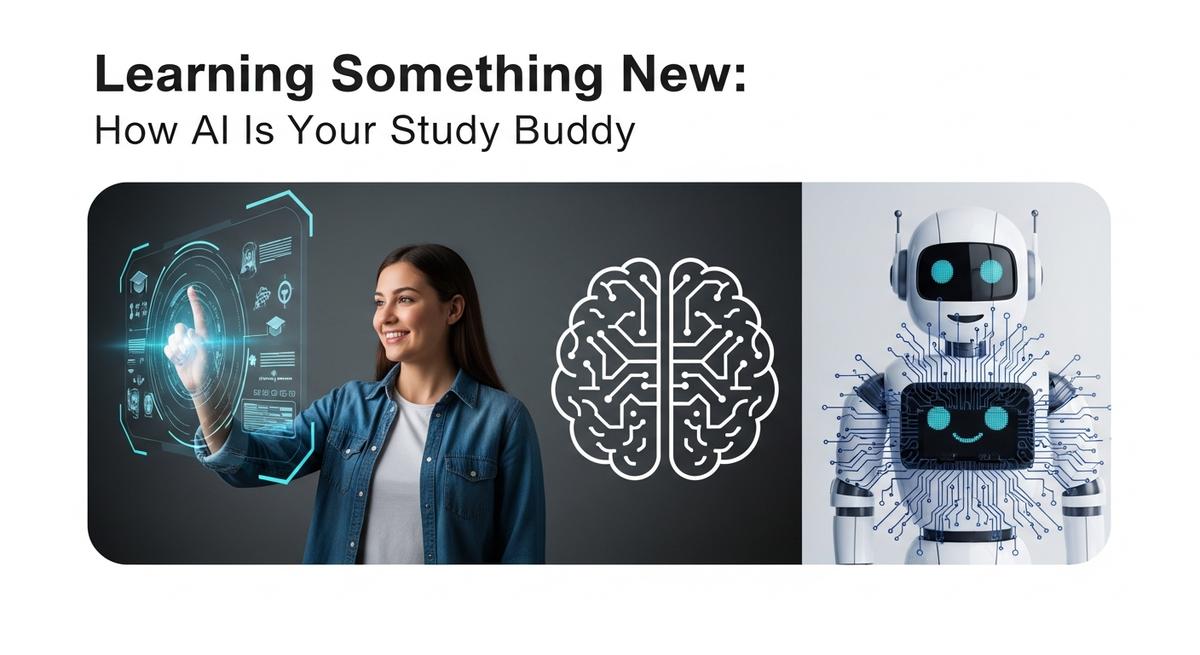
Learning Something New: How AI Is Your Study Buddy
- November 30, 2025
- ~ 1 min read
- 166 views
- AI in Education , Lifestyle & AI , GenAI
Introduction/Overview
Imagine it’s late at night, and you’re stuck on a challenging homework problem with no one around to ask for help. What if you had an AI study buddy ready to assist you instantly, offering personalized guidance and explanations tailored just for you? This scenario is no longer a futuristic fantasy but a rapidly growing reality thanks to advances in education technology. AI-powered tools are transforming how students learn by making support accessible anytime, anywhere, and adapting to each learner’s unique needs.
The Rise of AI as a Study Companion
Over the past few years, learning with AI has become an integral part of education for students, educators, parents, and lifelong learners alike. Unlike traditional study aids, AI companions provide personalized learning experiences by analyzing individual strengths and weaknesses, offering instant feedback, and adjusting content to match a student’s pace and style. These intelligent systems can summarize notes, generate practice quizzes, and even simulate interactive experiments, making learning more engaging and effective.
Why AI Matters in Today’s Educational Landscape
As classrooms become increasingly digital, AI’s role in education is expanding beyond simple automation to become a trusted partner in the learning journey. AI study buddies are available 24/7, breaking down barriers of time and location, and helping learners stay motivated through gamified challenges and progress tracking. For educators and parents, AI offers valuable insights into student performance, enabling targeted support that enhances academic outcomes and confidence. This shift is reshaping education by fostering personalized, efficient, and inclusive learning environments.
What to Expect in This Article
In this article, you will discover how AI functions as a practical and powerful study companion. We will explore real-world applications of AI in education, including:
- How AI personalizes learning paths to suit individual needs
- Ways AI provides instant feedback and interactive content
- How AI tools enhance accessibility and resource management
- Best practices for integrating AI study buddies responsibly
Whether you are a student seeking smarter study methods, an educator aiming to enrich your teaching toolkit, or a parent curious about the future of learning, this guide will equip you with actionable insights to harness the potential of AI as your ultimate study buddy.
Main Content
Understanding AI-Powered Learning Platforms
AI-powered learning platforms are sophisticated educational tools that leverage artificial intelligence to enhance the learning experience. These platforms collect and analyze data on student interactions, performance, and progress to tailor educational content dynamically. Imagine AI as a highly attentive tutor who continuously observes how you learn and adjusts lessons accordingly, ensuring you neither feel overwhelmed nor under-challenged. Examples like DreamBox and Smart Sparrow demonstrate this by adapting math and science lessons in real time, providing a learning journey uniquely suited to each student’s pace and abilities.
How AI Personalizes Learning Experiences
Personalized learning is at the heart of AI’s role in education. Unlike traditional one-size-fits-all teaching methods, AI customizes content to fit individual needs by analyzing a learner’s strengths, weaknesses, and preferences. For instance, platforms like Khan Academy use AI algorithms to recommend targeted practice exercises based on past performance, ensuring that each student focuses on areas needing improvement while reinforcing mastered concepts. This tailored approach increases engagement and retention by making study sessions more relevant and effective.
Instant Feedback and Guidance Through AI
One of AI’s most powerful features is its ability to provide AI feedback instantly. Instead of waiting for a teacher’s review, learners receive immediate, detailed explanations and hints that help them understand mistakes and concepts better. Tools like Socratic by Google allow students to photograph difficult homework questions and receive step-by-step guidance, mimicking the support of a personal tutor available 24/7. This timely feedback accelerates learning by correcting errors early and encouraging deeper comprehension.
Adapting to Individual Learning Styles
AI platforms excel at recognizing and adapting to diverse learning styles—whether visual, auditory, or kinesthetic. By continuously monitoring how students interact with content, AI adjusts the format, pacing, and difficulty of lessons to suit each learner’s unique approach. For example, if a student learns better through interactive simulations rather than text, the AI can prioritize those resources. This adaptive learning model transforms education from a rigid system into a flexible, personalized experience that maximizes each learner’s potential.
“AI acts like a tutor who knows exactly when you need help, what kind of help you need, and how to deliver it most effectively.”
By identifying individual strengths and weaknesses, AI optimizes study sessions, making learning more efficient and enjoyable. This shift towards personalized, adaptive learning not only supports academic success but also fosters confidence and motivation, empowering students, educators, and lifelong learners alike.
Examples and Use Cases
Popular AI-Powered Tutoring Systems
Leading educational platforms like Khan Academy and McGraw Hill have integrated advanced AI tutoring tools that transform how students engage with learning material. For example, Khan Academy’s AI tutor, Khanmigo, offers personalized guidance by asking probing questions and providing step-by-step feedback, especially in subjects like math and science. This approach encourages active cognitive engagement, helping students work through problems rather than just giving direct answers. Khanmigo can simulate interactive discussions, enabling learners to debate concepts or explore historical figures, thereby deepening understanding through constructive interaction. Similarly, McGraw Hill’s ALEKS system uses adaptive learning algorithms to tailor content difficulty and pacing, ensuring students are challenged just enough to stay motivated without feeling overwhelmed. These platforms emphasize AI tutoring that adapts in real time to individual progress, offering immediate feedback and personalized learning pathways that traditional tutoring methods struggle to scale effectively.
How Students Use AI for Homework Help, Grammar Checks, and Group Work
Students increasingly rely on AI tools to support everyday academic tasks. For homework help, AI-powered tutors provide instant explanations and hints, enabling learners to tackle challenging problems independently while receiving immediate feedback to correct misconceptions. Grammar and writing assistants powered by AI help students refine essays and reports by checking syntax, punctuation, and style, improving their writing skills with real-time suggestions. Additionally, AI facilitates collaborative learning by supporting group work; tools can help coordinate tasks, generate ideas, and even mediate discussions by summarizing points or suggesting next steps. This integration of AI into study routines enhances productivity and learning quality, making academic support accessible anytime and anywhere.
Real-World Implementations in Schools and Districts
Several schools and districts have embraced AI tools to enhance educational outcomes and streamline teaching workflows. A notable example is the Los Angeles Unified School District, which deployed an AI chatbot to assist students and educators with academic inquiries and administrative tasks. This implementation helps reduce teacher workload while providing students with quick access to homework help and study resources. Teachers benefit from AI-generated lesson plans and differentiated instruction materials tailored to diverse student needs, allowing more time for personalized attention and creative teaching. Other districts are experimenting with AI to identify learning gaps early, enabling timely interventions and fostering inclusive learning environments that support all students effectively.
Supporting Students with Disabilities and Language Learners
Inclusive learning is a key advantage of AI in education, particularly for students with disabilities and those learning new languages. AI-powered tools can provide tailored support such as text-to-speech, speech-to-text, and real-time translation services that accommodate diverse communication needs. For example, AI tutors can adjust the pace of instruction, simplify complex language, or offer alternative explanations to ensure comprehension for students with learning disabilities or limited English proficiency. These technologies help break down barriers, making education more accessible and equitable. By personalizing learning experiences to individual capabilities, AI fosters greater engagement and success among learners who might otherwise struggle in traditional classroom settings.
Advanced Concepts and Deep Dive
AI Algorithms and Data Models Powering Learning Platforms
At the core of AI-powered learning platforms lie sophisticated AI algorithms designed to analyze vast amounts of educational data. These algorithms leverage large datasets of student interactions, assessments, and content engagement to build predictive models that personalize learning experiences. Commonly, these models use techniques such as supervised and unsupervised machine learning, where the system learns patterns from labeled data or discovers structures without explicit guidance. For example, clustering algorithms group students by learning styles or knowledge gaps, while classification models predict the likelihood of mastering a concept based on past performance.
Data models often incorporate deep neural networks, which simulate interconnected layers of neurons to capture complex relationships within the data. These models are trained iteratively, adjusting internal parameters to minimize prediction errors, thus continuously improving their accuracy in tailoring educational content to individual learner needs. This data-driven adaptability enables platforms to recommend targeted resources, exercises, and feedback that align with each student's unique learning trajectory.
The Role of Machine Learning and Natural Language Processing
Machine learning and natural language processing (NLP) form the technological backbone of AI study companions. Machine learning algorithms analyze student input and interaction patterns to adapt content difficulty and presentation dynamically. Meanwhile, NLP enables AI systems to understand, interpret, and generate human language, facilitating natural, conversational interactions between learners and digital tutors.
NLP techniques such as tokenization, part-of-speech tagging, and sentiment analysis allow AI to comprehend student queries, provide instant explanations, and assess written responses. Advanced models like transformers—including BERT and GPT—process entire sentences or paragraphs simultaneously, capturing context and nuances that improve dialogue quality and content personalization. This synergy between machine learning and NLP empowers AI to simulate human-like tutoring, offering tailored explanations, clarifications, and encouragement in real time.
Detecting Learning Patterns and Real-Time Adaptation
One of the most powerful features of AI in education is its ability to detect subtle learning patterns through continuous monitoring of student behavior. By analyzing metrics such as time spent on tasks, error rates, and response times, AI systems identify strengths, weaknesses, and even shifts in motivation or engagement. These insights enable real-time adaptation, where the AI modifies the curriculum path, suggests supplementary materials, or adjusts question difficulty to optimize learning outcomes.
For instance, reinforcement learning algorithms allow AI to experiment with different teaching strategies, learning from student feedback to refine its approach. This dynamic personalization fosters a more efficient and engaging learning experience, accommodating diverse learner profiles and pacing. However, while AI excels at data-driven adaptation, it still requires human oversight to interpret complex emotional or social signals that influence learning.
Limitations in Understanding Emotional and Social Cues
Despite remarkable advances, AI systems currently face significant challenges in accurately interpreting emotional and social cues. While some platforms use sentiment analysis and facial recognition to gauge learner mood or frustration, these methods are limited by context ambiguity and privacy concerns. AI struggles to fully understand the nuances of human emotions, such as sarcasm, anxiety, or motivation fluctuations, which are critical for effective teaching and support.
Therefore, human educators remain essential to complement AI’s capabilities, providing empathy, encouragement, and social interaction that machines cannot replicate. The integration of AI as a study buddy is most effective when combined with human guidance, ensuring a balanced approach that respects the learner’s holistic needs beyond cognitive performance.
Ongoing Research and Future Advancements
Cutting-edge research is driving the future of AI in education toward even more immersive and effective learning environments. One promising direction is the integration of AI with virtual reality (VR) and augmented reality (AR), creating immersive simulations where learners can practice skills in realistic, interactive settings. AI algorithms analyze learner behavior within these environments to provide instant feedback and adjust scenarios dynamically.
Additionally, research into AI-driven educational interventions aims to simulate personalized tutoring strategies, adapting not only content but also teaching methods based on learner profiles. Advances in machine learning, such as self-supervised learning and few-shot learning, reduce the need for large labeled datasets, enabling AI to generalize better across diverse learners and subjects.
These innovations promise a future where AI not only supports knowledge acquisition but also fosters critical thinking, creativity, and lifelong learning skills in a deeply personalized and engaging manner.
Implementation Guide and Best Practices
Step-by-Step Guide to Start Using AI Tools for Students
Getting started with AI implementation in your study routine is easier than it seems. Follow these steps to integrate AI tools effectively:
- Choose the right AI tool: Start with user-friendly platforms like AI-powered flashcard apps, grammar checkers, or summarization tools that suit your learning needs.
- Set up your study materials: Upload or input your notes, textbooks, or assignments into the AI tool to generate summaries, quizzes, or brainstorming ideas.
- Establish a daily routine: Dedicate consistent time blocks—such as 30-45 minutes—to interact with AI tools, review content, and reflect on what you’ve learned.
- Track your progress: Use AI’s analytics features, if available, to monitor your understanding and adjust your study strategies accordingly.
- Gradually expand tool use: After mastering one tool, integrate complementary AI applications like spaced repetition software or collaborative platforms to deepen your learning experience.
This structured approach ensures a smooth transition into using AI as a study buddy while maintaining control over your learning process.
Best Practices to Maximize AI’s Benefits in Learning
To fully leverage AI’s potential, adopt these best practices that balance technology with your own cognitive skills:
- Use AI for idea generation and revision: Employ AI to brainstorm essay topics, generate outlines, or check grammar and style, but always personalize and critically evaluate the output.
- Maintain active engagement: Treat AI as a tool for support, not a replacement for independent thinking. Reflect on AI-generated content and question its accuracy.
- Incorporate diverse learning methods: Combine AI assistance with traditional study techniques like note-taking, group discussions, and practice tests to reinforce retention.
- Set clear goals for AI use: Define specific tasks where AI can add value, such as summarizing complex texts or providing instant feedback, to avoid aimless reliance.
- Practice digital literacy: Understand AI’s limitations and biases, and verify information from multiple sources to foster responsible and effective use.
Following these practices helps you harness AI’s strengths while preserving your critical thinking and creativity.
Avoiding Common Pitfalls: Balancing AI Assistance and Independent Learning
While AI offers powerful support, it’s crucial to avoid over-dependence. Here are key tips to maintain balance:
- Don’t submit AI-generated work as your own: Use AI outputs as drafts or inspiration, not final submissions, to uphold academic integrity.
- Limit AI use to enhancement, not substitution: Engage deeply with the material yourself before consulting AI to check your understanding.
- Be aware of AI errors: AI can produce plausible but incorrect information; always cross-check facts and reasoning.
- Develop self-reflection habits: Regularly assess how AI is influencing your learning and adjust your approach to maintain autonomy.
By consciously managing AI’s role, students can avoid complacency and continue building essential skills.
Tips for Educators Integrating AI into Teaching
Educators play a pivotal role in guiding responsible AI use. Consider these recommendations for effective integration:
- Set clear AI policies: Explicitly communicate when and how AI tools may be used in assignments, aligning with your course learning objectives.
- Foster digital literacy: Teach students about AI’s capabilities, limitations, and ethical considerations to develop critical evaluation skills.
- Design AI-compatible assignments: Create tasks that emphasize analysis, synthesis, and reflection rather than rote answers, making AI a complementary resource.
- Monitor AI use: Encourage transparency by having students document their AI interactions and reflect on how these tools supported their learning.
- Provide professional development: Stay informed about emerging AI tools and best practices to effectively support students and adapt teaching strategies.
Integrating AI thoughtfully enhances educational outcomes while preparing students for a digitally literate future.
Comparison and Analysis
AI-Powered Study Tools vs. Traditional Tutoring and Self-Study
When comparing AI-powered study tools to traditional tutoring and self-study, each method offers distinct benefits and challenges. AI tools provide personalized, data-driven learning paths that adapt in real time to a student’s pace and understanding, making them highly effective for structured subjects like math and programming. Research shows AI tutoring can accelerate learning speed by up to 87% compared to traditional methods, while also being significantly more affordable—costing around $15 per hour versus $65 for human tutors[1][2].
Traditional tutoring excels in delivering nuanced, empathetic support and motivation, which AI currently cannot fully replicate. Human tutors offer tailored explanations for complex topics and foster emotional connections that encourage persistence and confidence. Self-study, on the other hand, offers maximum flexibility but often lacks immediate feedback or personalized guidance, which can slow progress or lead to misunderstandings.
Advantages of AI as a Study Buddy
- Accessibility and Convenience: AI tools are available 24/7, allowing students to study anytime and anywhere without scheduling constraints[2][3].
- Personalization: Adaptive algorithms tailor lessons and practice exercises to individual learning gaps, accelerating skill acquisition and reinforcing weak areas effectively[3][4].
- Instant Feedback: AI provides immediate corrections and hints, enabling students to learn from mistakes in real time and maintain momentum[3].
- Cost-Effectiveness: AI tutoring offers scalable solutions that dramatically reduce costs compared to one-on-one human tutoring, making quality education more accessible[1][2].
- Consistency and Patience: AI delivers standardized, non-judgmental support, ideal for repetitive practice and test preparation[1].
Limitations and Trade-Offs of AI Study Tools
- Lack of Emotional Support: AI cannot fully replicate the empathy, encouragement, and motivational nuances human tutors provide, which are crucial for learner confidence and engagement[1][3].
- Limited Complex Problem-Solving: AI excels in structured tasks but may struggle with open-ended, creative, or deeply conceptual questions requiring human insight[2][4].
- Risk of Misuse: Overreliance on AI tools or using them as shortcuts can hinder critical thinking and independent learning skills development.
- Social Interaction Deficit: AI-based study lacks the collaborative and communicative aspects that traditional learning environments foster, important for holistic development[3].
When to Use AI vs. Human Support: A Balanced Approach
Choosing between AI and human tutoring depends on the learner’s goals, subject complexity, and personal preferences. AI is ideal for:
- Structured, repetitive practice and test preparation where immediate feedback and scalability are priorities.
- Students seeking affordable and flexible learning options that fit busy schedules.
- Building foundational skills and reinforcing knowledge gaps efficiently.
Human tutors are preferable when:
- Emotional support, motivation, and personalized encouragement are needed to overcome learning barriers.
- Engaging with complex, abstract concepts that require adaptive reasoning and dialogue.
- Developing social and communication skills through interactive learning.
Hybrid study methods that combine AI’s personalized, scalable support with human tutors’ empathy and expertise have shown the best outcomes, leveraging the strengths of both approaches[1][2][5]. This balanced strategy can optimize learning efficiency while maintaining the human connection essential for meaningful education.
| Aspect | AI Study Tools | Human Tutors |
|---|---|---|
| Availability | 24/7 access, anytime learning | Scheduled sessions, limited hours |
| Personalization | Adaptive, data-driven learning paths | Tailored explanations and emotional cues |
| Cost | Low, scalable for many users | Higher, one-on-one personalized attention |
| Feedback | Instant, automated corrections | Nuanced, context-aware guidance |
| Emotional Support | Minimal or none | Strong, motivational, empathetic |
| Social Interaction | Limited or absent | Encourages communication and collaboration |
Conclusion and Key Takeaways
As we conclude this exploration of AI in education, it is clear that artificial intelligence serves as a powerful study buddy, enhancing learning experiences in unprecedented ways. From personalized tutoring and adaptive assessments to around-the-clock accessibility, AI tools offer students, educators, parents, and lifelong learners tailored support that can boost engagement and academic success. However, while AI's capabilities are impressive, it remains essential to remember that these technologies should complement rather than replace human interaction, critical thinking, and the empathetic guidance that educators provide.
Balancing Benefits and Limitations
The benefits of AI in education are significant: personalized learning paths, immediate feedback, content customization, and expanded accessibility for diverse learners. These advantages help close skill gaps and allow learners to progress at their own pace. Yet, there are important limitations to consider. Overreliance on AI can diminish critical thinking and problem-solving skills, and the lack of human empathy in AI-driven learning environments poses challenges for social and emotional development. Moreover, ethical considerations such as data privacy, algorithmic bias, and equitable access must be carefully managed to prevent unintended consequences. Recognizing these factors ensures AI remains a responsible and effective educational tool.
Next Steps: Embrace, Explore, and Stay Informed
To make the most of AI as your study buddy, explore diverse AI tools and experiment with those that best fit your learning style and goals. Students should seek guidance from teachers and mentors to integrate AI thoughtfully into their study routines, while educators can benefit from professional development focused on AI literacy. Staying informed about the ethical considerations surrounding AI—such as privacy protections and fairness in algorithms—is crucial for fostering a safe and inclusive learning environment.
We encourage you to share your experiences with AI-powered learning tools, discuss challenges and successes, and continue the conversation about how AI can best support education. By combining human insight with intelligent technology, the future of learning holds exciting possibilities for all.

Comments (0)
Please login or register to leave a comment.
No comments yet. Be the first to comment!