
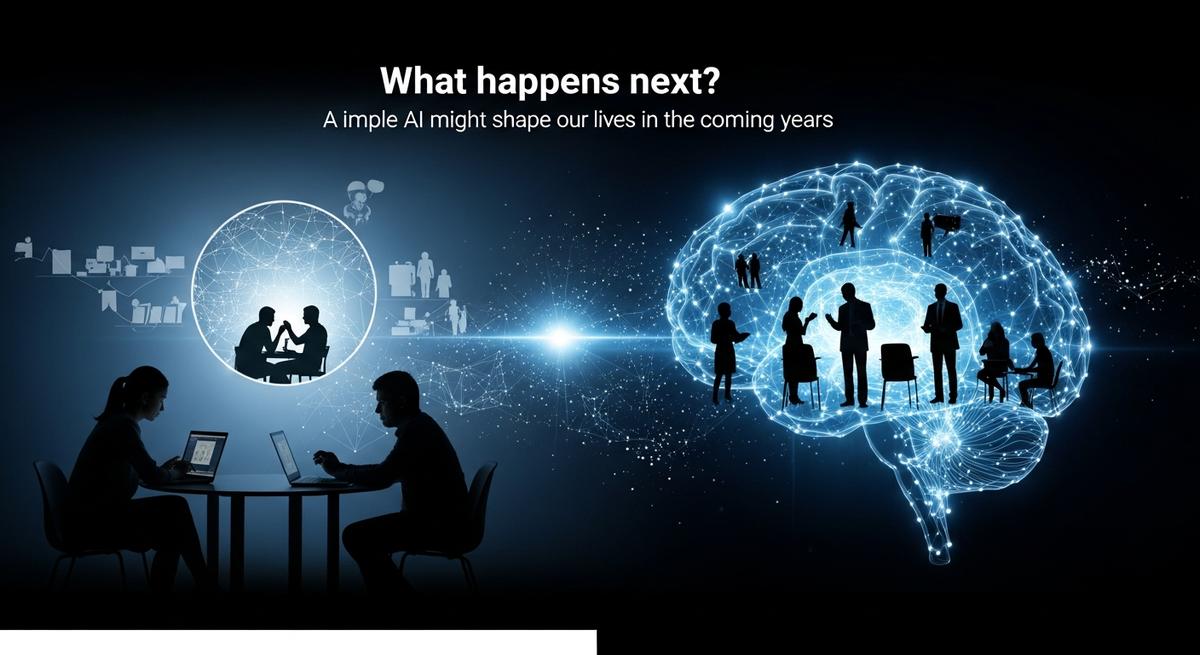
What happens next? A simple look at how AI might shape our lives in the coming years
- November 22, 2025
- ~ 1 min read
- 279 views
- Everyday AI , Future of Work , Lifestyle & AI
Introduction/Overview
Artificial intelligence (AI) is no longer a distant concept confined to science fiction; it has become an integral part of our daily life. From virtual assistants that manage our schedules to AI-driven tools transforming industries, the rapid evolution of artificial intelligence is reshaping how we live, work, and interact. Recent breakthroughs in AI capabilities—such as advanced natural language processing, real-time data analysis, and generative models—are accelerating this transformation at an unprecedented pace, making AI a powerful force in today’s world.
Understanding the AI future is essential not only for technology enthusiasts but for everyone—from professionals and decision-makers to everyday consumers—because AI’s influence will touch every aspect of society. As AI systems become more sophisticated and widespread, they will affect job markets, healthcare, education, and even how we manage our homes and personal well-being. Being informed about these changes equips us to navigate new opportunities and challenges responsibly and proactively.
Why AI’s Future Matters to Everyone
AI’s integration into society is accelerating, with over 78% of organizations worldwide already adopting AI technologies to enhance productivity and innovation. This trend is expected to grow, with AI projected to add trillions of dollars to the global economy within the next few years. The technology’s ability to automate routine tasks and augment human decision-making means it will redefine roles across industries, influencing how we work and the skills we need to thrive. Moreover, AI’s impact extends beyond economics, shaping social dynamics, ethical considerations, and even public policy.
Key Areas Where AI Will Shape Our Lives
This article will demystify the complex landscape of AI’s future impact in simple, accessible terms. We will explore how AI is set to transform:
- Work: Enhancing productivity, automating repetitive tasks, and creating new job opportunities.
- Health: Improving diagnostics, personalized medicine, and patient care through intelligent data analysis.
- Daily Routines: Streamlining everyday activities with smart assistants, personalized recommendations, and AI-powered tools.
- Society: Influencing education, governance, ethical frameworks, and social interactions on a broad scale.
By understanding these developments, readers will gain a clearer picture of how artificial intelligence is poised to shape the near future and what it means for individuals and communities alike.
Main Content
From Speed to Smarter, Context-Aware AI
Artificial intelligence is evolving beyond simply processing tasks faster. The next wave of AI development focuses on context-aware AI and multimodal learning, where systems understand and integrate information from multiple sources—such as text, images, audio, and sensor data—to make more nuanced decisions. Unlike early AI models that excelled at narrow, speed-focused tasks, these advanced systems grasp the broader context of interactions, enabling more intuitive and human-like responses.
For example, a context-aware AI assistant won’t just schedule meetings based on availability; it will understand preferences, anticipate needs, and adapt dynamically to changing circumstances. This shift means AI will become less about raw speed and more about delivering meaningful, relevant assistance in complex, real-world environments.
AI Integration into Infrastructure, Healthcare, and Personal Services
The integration of AI into critical infrastructure and everyday services is accelerating. In healthcare, AI is transforming everything from diagnostics to patient monitoring. AI-powered imaging tools analyze X-rays and MRIs with remarkable accuracy, enabling earlier disease detection and personalized treatment plans. Telemedicine platforms now use AI to monitor patient vitals remotely, alerting healthcare providers to potential issues before they become critical.
This transformation requires robust, flexible IT infrastructure that can handle large volumes of data in real time. Healthcare organizations are upgrading to hybrid cloud and edge computing solutions to support these AI applications efficiently. Similarly, AI is being embedded into personal services such as smart home devices, virtual assistants, and personalized learning platforms, making technology more seamless and less intrusive in daily life.
These developments illustrate how AI integration is not just about adding new tools but rethinking systems to be smarter, interconnected, and more adaptive.
The Rise of Machine Co-Workers and Collaborative AI Environments
One of the most transformative trends is the emergence of AI as machine co-workers rather than mere tools. In workplaces, AI systems are increasingly designed to collaborate alongside humans, augmenting their capabilities rather than replacing them. These AI colleagues can handle routine data analysis, generate insights, or manage scheduling, freeing human workers to focus on creative and strategic tasks.
For instance, in healthcare, AI can assist clinicians by summarizing patient histories or suggesting treatment options based on vast medical databases. In offices, AI-driven platforms help teams coordinate projects by understanding context and anticipating needs. This collaborative environment fosters a symbiotic relationship where human judgment and AI efficiency combine to improve productivity and decision-making.
Understanding the Limitations: Specialized AI, Not General Intelligence by 2030
Despite rapid advances, experts agree that AI will remain largely specialized rather than achieving general-purpose intelligence by 2030. Current AI systems excel in specific domains but lack the broad, flexible understanding humans possess. This means AI will continue to support targeted tasks—whether in healthcare, logistics, or customer service—without fully autonomous reasoning across all contexts.
Recognizing these limitations is crucial for managing expectations and guiding responsible AI development. The focus will be on creating reliable, explainable, and ethically governed AI systems that enhance human capabilities without overpromising on autonomy or intelligence.
“AI will become more intuitive and less visible, seamlessly supporting daily activities across sectors, but it will remain a specialized collaborator rather than a universal problem solver.”
Examples and Use Cases
AI-Powered Health Monitoring and Early Disease Detection
Imagine a family at home using AI health monitoring devices that continuously track vital signs such as heart rate, blood pressure, and glucose levels. These smart wearables and connected devices analyze real-time data to detect subtle changes that might indicate the early onset of conditions like diabetes or heart disease. For example, an AI system could alert a parent if their child’s irregular heartbeat patterns suggest a potential cardiac issue, prompting early medical consultation before symptoms worsen.
Beyond wearables, AI algorithms are increasingly integrated into diagnostic tools in clinics and hospitals, analyzing medical images and lab results with remarkable accuracy. This enables earlier and more precise detection of diseases such as cancer or neurological disorders, improving treatment outcomes. The seamless integration of AI into daily health monitoring empowers individuals to take proactive control of their well-being, reducing emergency visits and healthcare costs.
AI-Driven Personalized Education and Adaptive User Interfaces
In education, personalized education powered by AI is transforming how students learn. Adaptive platforms like DreamBox and Smart Sparrow dynamically adjust lessons based on each learner’s strengths, weaknesses, and pace. For instance, a middle school student struggling with math might receive customized problem sets that gradually increase in difficulty, while another excelling in the subject is challenged with advanced concepts to keep them engaged.
AI also enables virtual tutoring tools such as Socratic by Google, where students can snap a photo of a difficult homework question and receive tailored, step-by-step explanations. This on-demand assistance helps learners overcome hurdles immediately, fostering confidence and deeper understanding.
Moreover, adaptive user interfaces powered by AI personalize digital experiences beyond education — from websites that adjust content layout based on user preferences to software that modifies accessibility features for users with disabilities. This intelligent customization ensures a more inclusive and effective interaction with technology across diverse user groups.
AI in Sustainability: Smart Grids and Environmental Monitoring
AI sustainability applications are crucial in addressing environmental challenges. Smart grids, for example, use AI to optimize energy distribution by predicting demand patterns and integrating renewable energy sources efficiently. This reduces waste and lowers carbon emissions, contributing to greener cities.
Environmental monitoring systems equipped with AI analyze data from sensors tracking air and water quality, deforestation, and wildlife populations. These systems can detect pollution spikes or habitat changes in real time, enabling faster response from authorities and conservationists. For example, AI-driven drones might monitor forest health and alert teams to early signs of wildfire risks, helping prevent large-scale disasters.
By leveraging AI’s analytical power, communities and governments can make data-driven decisions to promote sustainability, protect natural resources, and combat climate change more effectively.
AI’s Role in Legal, Media, and Creative Industries
In the legal sector, AI tools assist lawyers by automating document review, contract analysis, and legal research, significantly speeding up case preparation. AI-powered platforms can identify relevant precedents and flag inconsistencies, allowing legal professionals to focus on strategy and client interaction.
Within the media industry, AI in media is revolutionizing content creation and verification. Journalists collaborate with AI systems that perform rapid fact-checking, summarize lengthy reports, and even suggest story angles based on trending topics. This partnership enhances accuracy and productivity, enabling faster news delivery without compromising quality.
Creative fields such as design, music, and writing are also embracing AI-generated content. Artists use AI tools to generate ideas, compose music, or create visual art, blending human creativity with machine efficiency. For example, a filmmaker might use AI to storyboard scenes or simulate lighting effects before shooting, saving time and resources.
These applications highlight how AI augments human expertise across professional domains, fostering innovation while maintaining creative and ethical standards.
Advanced Concepts and Deep Dive
The Rising Role of Synthetic Data in AI Models
As artificial intelligence continues to evolve, the demand for vast, high-quality datasets has become a critical bottleneck. Synthetic data—artificially generated data that mimics real-world patterns—has emerged as a transformative solution to this challenge. Unlike traditional real-world data, synthetic data can be produced at scale without privacy risks, enabling AI models to train on diverse and comprehensive datasets without exposing sensitive information.
This shift is accelerating rapidly: industry experts and analysts predict that by 2030, synthetic data will completely overshadow real data in AI model training, becoming the dominant data source across sectors. The advantages are clear—synthetic data allows for unlimited generation of labeled datasets, dramatically reducing the cost and time associated with manual data collection and annotation. Moreover, it can fill gaps in real data, generate rare edge cases, and help correct biases by balancing underrepresented groups, leading to fairer and more robust AI systems.
In practice, synthetic data is increasingly integrated into AI development workflows (MLOps), where automated pipelines generate, validate, and deploy synthetic datasets. This integration accelerates iteration and model improvement, making synthetic data not just a workaround but a core component of future AI infrastructure.
Scaling AI Infrastructure: Compute and Energy Demands
Behind every AI breakthrough lies a complex and rapidly scaling infrastructure. The growth of AI models—especially large language models and multimodal systems—requires enormous computational power and energy resources. This AI scaling involves expanding hardware capabilities such as GPUs, TPUs, and specialized AI accelerators, as well as optimizing data centers for energy efficiency.
However, this scaling comes with significant challenges. The demand for compute and energy is rising exponentially, pushing the limits of current technology and sustainability. To address this, researchers and engineers are innovating in hardware design, algorithm efficiency, and distributed computing architectures. Techniques like model pruning, quantization, and federated learning help reduce computational costs while maintaining performance.
Furthermore, the integration of synthetic data supports this scaling by enabling faster, more efficient training cycles with less reliance on costly real-world data collection. Together, these advances in AI infrastructure and data generation are propelling unprecedented scientific and technological progress.
Advancements in Scientific R&D Driven by AI
AI is revolutionizing scientific research and development by automating complex tasks and accelerating discovery. One of the most exciting frontiers is AI-driven software that assists in mathematical proof generation, hypothesis testing, and data analysis. These systems can explore vast solution spaces, identify patterns invisible to human researchers, and propose novel theories.
For example, AI models trained on synthetic and real scientific data are now capable of verifying intricate mathematical proofs, suggesting experimental designs, and optimizing chemical compounds. This synergy between AI and scientific R&D is shortening development cycles in fields such as pharmaceuticals, materials science, and climate modeling, ultimately driving innovation at a scale and speed previously unattainable.
By leveraging scientific R&D tools powered by AI, researchers can focus more on creative problem-solving while AI handles routine or computationally intensive tasks. This marks a profound shift in how science is conducted, with AI becoming an indispensable collaborator.
The Shift to AI-Centric Software Interaction Models
Traditional software interfaces have been human-centric, designed primarily for direct user input and control. However, the rise of AI is transforming this paradigm toward AI-centric interaction models, where AI systems actively mediate, augment, or even autonomously perform tasks on behalf of users.
This shift is characterized by more natural, conversational interfaces powered by large language models, contextual understanding, and adaptive learning. Instead of users navigating complex menus or coding environments, AI agents interpret intent, provide proactive assistance, and dynamically adjust workflows.
Such AI-centric models enable more intuitive and efficient interactions across domains—from personalized education and healthcare to enterprise software and creative tools. They also raise new considerations for transparency, control, and trust, as users increasingly rely on AI to shape outcomes.
Ultimately, this evolution reflects a deeper integration of AI into daily life, where software not only responds to human commands but anticipates needs and collaborates seamlessly.
Implementation Guide and Best Practices
Actionable Steps for Individuals to Embrace AI in Daily Life
Embracing AI adoption at a personal level starts with integrating simple, accessible tools that enhance productivity and learning. Begin by exploring AI-powered virtual assistants like Siri, Alexa, or Google Assistant to automate routine tasks such as scheduling, reminders, and information retrieval. Next, experiment with AI-driven productivity apps that help organize emails, manage calendars, or generate content, enabling you to save time and focus on higher-value activities.
For continuous growth, leverage AI-powered learning platforms that personalize education based on your pace and interests. This approach not only boosts skills but also cultivates familiarity with AI technologies, preparing you for broader applications in work and life. Importantly, maintain an ethical mindset by understanding how your data is used and protecting your privacy when engaging with AI tools.
Guidance for Businesses on Adopting AI Responsibly and Ethically
Businesses aiming for successful AI integration should start with a strategic assessment to align AI initiatives with core objectives. Organize cross-functional workshops to identify relevant use cases where AI can add tangible value, such as automating workflows or enhancing customer experiences. Pilot projects using no-code AI platforms allow quick validation without heavy upfront investment, enabling iterative learning and adjustment.
Adopting responsible AI means embedding ethical considerations from the outset. This includes ensuring transparency in AI decision-making, safeguarding user data, and complying with privacy regulations. Engage stakeholders across departments to foster a culture of trust and collaboration between humans and AI systems. Continuously monitor AI performance and impact, refining models to avoid biases and unintended consequences.
Best Practices for Leveraging AI in Education and Healthcare
In education, leverage AI to personalize learning experiences, adapting content and pace to individual student needs. Use AI tools to automate administrative tasks, freeing educators to focus on teaching and mentorship. Encourage educators and students to engage with AI critically, understanding its capabilities and limitations.
In healthcare, apply AI to enhance diagnostics, patient monitoring, and treatment planning. Best practices include integrating AI systems with existing workflows to support healthcare professionals rather than replace them, ensuring accuracy through rigorous validation, and prioritizing patient data privacy. Ongoing training for healthcare workers on AI tools fosters effective adoption and ethical use.
Common AI Pitfalls to Avoid
While embracing AI, it is crucial to avoid common pitfalls that can undermine its benefits. Over-reliance on AI without human oversight can lead to errors or loss of critical thinking. Ignoring privacy concerns risks data breaches and erosion of user trust. Additionally, neglecting continuous learning and adaptation may cause AI systems to become outdated or biased.
Best practices emphasize a balanced approach: use AI to augment human capabilities, maintain transparency, and regularly review AI impacts to mitigate risks.
By following these guidelines, individuals and organizations can harness AI’s potential responsibly and effectively, shaping a future where AI enhances daily life and societal well-being.
Comparison and Analysis
Balancing the AI Pros and Cons
Artificial intelligence promises transformative benefits, including enhanced efficiency, improved personalization, and automation of routine tasks that can free human creativity and innovation. For example, AI-driven automation in manufacturing and administrative sectors accelerates productivity and reduces human error, while AI-powered personalized recommendations improve user experiences in education and healthcare. However, these advantages come with significant challenges. The most pressing concerns include job displacement as AI automates roles traditionally performed by humans, raising fears about economic instability and workforce disruption. Additionally, AI systems introduce privacy risks through extensive data collection and raise ethical questions about bias and accountability in decision-making algorithms.
Consider the trade-off between automation and job security: while AI can create new high-skilled jobs, it often replaces low-skilled positions, disproportionately affecting vulnerable demographics and deepening economic divides. Thus, the benefits of AI must be weighed carefully against its societal risks to ensure inclusive progress.
Exploring Hybrid AI Systems as an Alternative
Rather than pursuing full automation, many experts advocate for hybrid human-AI systems that combine the strengths of both. These systems leverage AI's computational power and data analysis capabilities while preserving human judgment, creativity, and ethical oversight. For example, in healthcare, AI assists doctors by rapidly analyzing medical images or patient data, but final treatment decisions remain human-led, ensuring empathy and contextual understanding.
This approach mitigates some AI trade-offs by maintaining human agency and reducing risks associated with overreliance on AI, such as cognitive complacency or loss of critical thinking skills. Hybrid systems also facilitate workforce transformation by augmenting rather than replacing human roles, fostering collaboration and continuous learning.
Trade-offs Between Rapid Innovation and Ethical Considerations
The pace of AI innovation is accelerating, offering unprecedented opportunities for economic growth, scientific advancement, and societal improvement. However, rapid deployment without robust ethical frameworks can lead to unintended consequences like algorithmic bias, erosion of privacy, and loss of transparency in decision-making.
Organizations and policymakers face difficult trade-offs: prioritizing speed may yield short-term gains but risks long-term harm if ethical and safety concerns are neglected. Conversely, emphasizing ethics and safety may slow innovation but builds public trust and sustainable adoption. Responsible AI development requires balancing these competing priorities through transparent governance, accountability, and inclusive stakeholder engagement.
Impact of AI Across Sectors and Demographics
The AI impact varies widely by sector and population group. In healthcare, AI improves diagnostics and personalized treatment, potentially reducing disparities in access to quality care. In finance, AI enhances fraud detection and customer service but raises concerns about data privacy.
Demographically, AI tends to benefit those with access to education and digital resources, risking widening the digital divide. Low-income and developing regions may face challenges in adopting AI equitably, risking further marginalization if ethical and infrastructural considerations are not addressed.
Ultimately, the future of AI depends on deliberate choices to harness its benefits while mitigating risks, ensuring that innovation leads to inclusive, ethical, and sustainable societal transformation.
Conclusion and Key Takeaways
Artificial intelligence is set to be a defining force in shaping our lives and society in the coming years. The AI transformation will touch every sector—from healthcare and education to finance and transportation—bringing unprecedented efficiency, personalization, and innovation. As AI systems become more capable, they will not only augment human abilities but also redefine how we work, learn, and interact with the world around us.
Summarizing AI’s Transformative Potential
Throughout this article, we have explored how AI will revolutionize daily life by enabling smarter decision-making, automating routine tasks, and accelerating scientific research. By 2030 and beyond, AI-driven advances such as predictive healthcare, autonomous vehicles, and personalized education will become integral parts of our routines. These developments promise to improve quality of life and economic productivity, while also presenting complex challenges such as workforce shifts and privacy concerns. The scale and speed of change highlight AI’s role as a transformative, not incremental, technology.
The Importance of Proactive Adaptation and Ethical Awareness
With great power comes great responsibility. The future of AI depends heavily on how we approach its development and deployment today. Embracing a mindset of ethical AI is critical to ensure that AI systems are designed and governed with fairness, transparency, and respect for human rights. Proactive adaptation means preparing for workforce transitions, updating policies, and fostering inclusive access to AI’s benefits. It requires collaboration among governments, businesses, and individuals to navigate risks such as bias, job displacement, and privacy infringements while maximizing positive impact.
Staying Informed and Engaged with AI Developments
As AI continues to evolve rapidly, ongoing learning and active engagement are essential. Staying informed about emerging AI trends, breakthroughs, and ethical debates empowers individuals and decision-makers to make thoughtful choices and advocate for responsible AI use. We encourage readers to explore trusted resources, participate in discussions, and contribute to shaping an AI-powered future that aligns with human values and societal well-being.
“The choices we make today around AI ethics, governance, and education will determine the shape of our shared future.”
In closing, AI’s journey is just beginning, and its full impact will unfold over decades. By embracing both the opportunities and challenges with foresight and responsibility, we can harness AI’s potential to create a more innovative, equitable, and sustainable world. Join the conversation, stay curious, and be part of this transformative era.
Comments (0)
Please login or register to leave a comment.
No comments yet. Be the first to comment!