
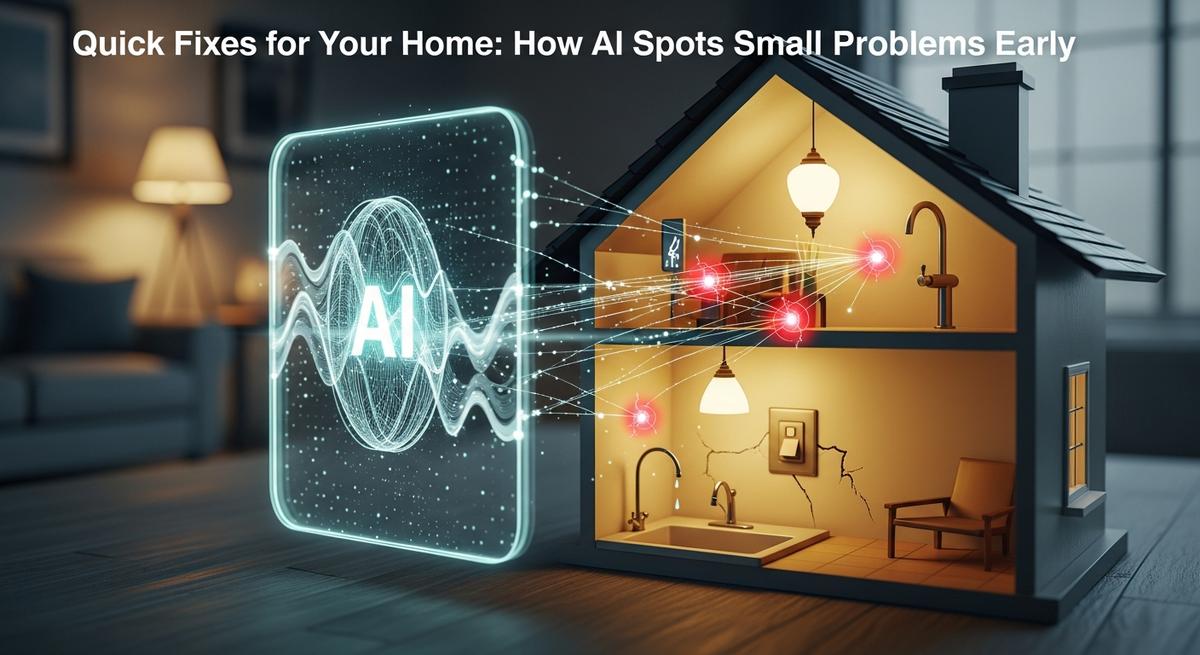
Quick Fixes for Your Home: How AI Spots Small Problems Early
- December 01, 2025
- ~ 1 min read
- 305 views
- Everyday AI , AI Agents
Introduction to AI in Home Maintenance
Imagine discovering a small water leak behind your kitchen wall only after it has caused significant mold damage and costly repairs. Many homeowners face this frustrating scenario, where minor issues quietly worsen over time, leading to unexpected expenses and stress. Traditional home maintenance often relies on periodic manual inspections or waiting for visible signs of trouble—an approach that can miss early warning signs and result in emergency fixes.
Enter AI home maintenance, a revolutionary approach that leverages advanced smart home technology to detect small problems before they escalate. By continuously monitoring your home's vital systems—such as plumbing, electrical, HVAC, and structural elements—AI-powered sensors and devices identify subtle anomalies that human eyes might overlook. This early problem detection enables homeowners to address issues proactively, saving both time and money.
The Transformative Role of AI in Home Care
Artificial intelligence is reshaping how we maintain our homes by providing real-time insights and predictive analytics. Through integration with Internet of Things (IoT) devices, AI systems can:
- Detect water leaks and unusual moisture levels early, preventing water damage.
- Monitor energy consumption patterns to spot inefficiencies or electrical faults.
- Analyze HVAC performance to predict failures and optimize energy use.
- Alert homeowners instantly via smartphone apps, enabling swift action.
These capabilities transform home maintenance from a reactive chore into a streamlined, proactive process. Homeowners gain peace of mind knowing their property is continuously monitored by intelligent systems designed to catch problems at their inception.
Why Early Problem Detection Matters for Homeowners
Early detection of home maintenance issues is crucial for several reasons:
- Cost savings: Fixing minor problems before they worsen prevents expensive repairs and extends the lifespan of home systems.
- Safety: Identifying faults early reduces risks such as electrical fires, water damage, or HVAC malfunctions.
- Convenience: Automated alerts and maintenance scheduling simplify upkeep, allowing homeowners to focus on other priorities.
- Property value preservation: Proactive care helps maintain your home's condition and market value over time.
In this article, we will explore how AI home maintenance technologies work to spot small problems early and offer actionable solutions that empower you to keep your home in optimal condition. From smart sensors to predictive analytics, discover how embracing AI can transform your approach to home care, making maintenance smarter, easier, and more effective.
Understanding AI Technologies for Early Problem Detection
AI-Powered Sensors and IoT Integration in Homes
At the heart of early problem detection in modern homes lies the seamless integration of IoT sensors and advanced AI technologies. IoT (Internet of Things) sensors are strategically installed in key areas of a home to continuously monitor critical parameters such as temperature, humidity, water presence, pressure, and energy consumption. These sensors generate real-time data streams that provide a detailed snapshot of the home's operational health.
For example, sensors placed near plumbing fixtures can detect subtle changes in water pressure or moisture levels, signaling a potential leak before it causes significant damage. Similarly, sensors embedded in HVAC systems track temperature fluctuations and airflow efficiency. These devices communicate wirelessly through protocols like Wi-Fi, ZigBee, or Z-Wave to a centralized gateway or smart home hub, which then relays the data to cloud-based AI platforms for analysis.
Predictive Maintenance Algorithms Analyzing Real-Time Data
The raw data collected by IoT sensors is only the beginning. The true power of early problem detection comes from machine learning in home maintenance, where AI algorithms analyze these data streams to identify patterns, anomalies, and early warning signs of failure. This process, known as predictive maintenance, moves beyond traditional reactive or scheduled upkeep by forecasting issues before they escalate.
Machine learning models are trained on historical and real-time data to recognize normal operating conditions and detect deviations that may indicate inefficiencies or faults. For instance, a slight increase in energy consumption by an HVAC unit may signal a developing mechanical problem or clogged filters. The AI system can then predict the likelihood and timing of a failure, enabling homeowners or property managers to take proactive action.
These algorithms also generate actionable insights and recommendations, such as scheduling repairs, adjusting system settings, or optimizing energy use, thus enhancing convenience and cost savings.
Types of Home Systems Monitored and Anomalies Detected
AI-driven early detection systems monitor a wide range of essential home systems, including:
- HVAC Systems: Monitoring temperature, airflow, and energy use to detect inefficiencies, filter issues, or potential breakdowns.
- Plumbing: Detecting leaks, drops in water pressure, or unusual moisture levels to prevent water damage.
- Electrical Systems: Tracking power usage and circuit behavior to identify faults or risks such as frequent breaker trips.
- Appliances: Observing performance metrics to flag malfunctions early, extending appliance lifespan.
By continuously analyzing sensor data, AI can detect anomalies such as leaks, inefficiencies, or faults that are often invisible to the naked eye. For example, AI might identify a minor plumbing leak from a subtle pressure drop or recognize an HVAC system running longer than usual to maintain temperature, signaling a need for maintenance.
“Predictive maintenance powered by AI and IoT sensors transforms home care from reactive to proactive, saving costs, enhancing safety, and improving system longevity.”
Overall, the integration of IoT sensors with sophisticated AI algorithms enables homeowners to catch small problems early, ensuring timely repairs and maintaining the health and efficiency of their homes.
Real-World Applications and Success Stories
AI Detecting a Slow Plumbing Leak to Prevent Water Damage
One of the most compelling examples of AI leak detection in action involves a homeowner who avoided extensive water damage thanks to an AI-powered sensor system. This system continuously monitored moisture levels and water flow in plumbing pipes, identifying a slow leak that was invisible to the naked eye. By alerting the homeowner early, the AI technology enabled timely repairs before the leak escalated into costly structural damage or mold growth. This proactive approach not only saved thousands in repair bills but also prevented the disruption and stress associated with major water damage restoration.
Such AI solutions leverage real-time data and machine learning algorithms to detect anomalies in water usage patterns, offering a clear example of how early problem detection can protect homes effectively.
Optimizing HVAC Performance and Reducing Energy Bills
Energy optimization AI has revolutionized how homeowners manage heating, ventilation, and air conditioning (HVAC) systems. AI-driven predictive maintenance tools analyze sensor data like temperature, airflow, and pressure to identify inefficiencies such as clogged filters or refrigerant leaks long before they cause system failure. For instance, a property manager utilized AI to detect subtle HVAC performance drops, allowing maintenance teams to act proactively. This early intervention improved system reliability, extended equipment lifespan, and significantly lowered energy consumption and operational costs.
By optimizing HVAC performance, AI not only enhances comfort but also contributes to sustainable energy use and reduced utility bills, demonstrating a practical benefit for both homeowners and property managers.
AI-Powered Smart Diagnostic Tools via Smartphone Apps
Advances in smart diagnostics have put powerful AI tools directly into homeowners' hands through intuitive smartphone apps. These apps allow users to diagnose household issues simply by uploading photos or videos of suspected problems. The AI algorithms analyze visual data to identify issues such as cracked walls, damaged roofs, or appliance malfunctions, providing instant, expert-level assessments without the need for costly technician visits.
For DIY enthusiasts and tech-savvy homeowners, these tools offer a convenient and cost-effective way to make informed decisions about repairs. They also streamline communication with professional repair services by providing detailed diagnostic reports, which can speed up scheduling and improve repair accuracy.
Integration of AI with Home Security and Energy Management Systems
Beyond maintenance, AI integration with home security and energy management systems is creating smarter, more resilient homes. AI-powered security systems use real-time data to detect unusual activity, alerting homeowners instantly to potential threats or system malfunctions. Simultaneously, these systems optimize energy use by learning household patterns and adjusting lighting, heating, and cooling accordingly.
This holistic AI integration not only enhances safety but also drives efficiency, reducing energy waste and lowering bills. Together, these technologies create a connected home environment where early problem detection and automated responses work hand-in-hand to maintain comfort, security, and savings.
Deep Dive into AI’s Technical Mechanisms and Expert Insights
Understanding Predictive Maintenance and Anomaly Detection Algorithms
At the core of AI-driven home maintenance lies anomaly detection algorithms, which continuously analyze real-time data streams from household systems to identify deviations from normal operational patterns. These algorithms leverage machine learning models trained on historical and sensor data, enabling them to detect subtle signs of wear or malfunction before they escalate into major issues. By learning from patterns such as temperature fluctuations, vibration irregularities, or unexpected noise levels, the AI can forecast potential failures and recommend timely interventions. This predictive capability shifts maintenance from a reactive to a proactive model, reducing downtime and repair costs while extending the lifespan of home appliances and systems.
Technically, these algorithms employ methods like supervised learning for known fault patterns and unsupervised learning to identify novel anomalies without prior labeling. Deep learning architectures, including recurrent neural networks (RNNs), are often utilized to capture temporal dependencies in sensor data, improving prediction accuracy over time. This continuous learning process allows the system to adapt to changes in appliance behavior, environmental conditions, or user habits, making the predictions increasingly precise.
Acoustic and Vibration Analysis in Appliance Health Monitoring
Acoustic monitoring AI plays a pivotal role in detecting early-stage faults by analyzing sound signatures emitted by appliances. Microphones and vibration sensors capture audio and mechanical oscillations, which AI algorithms process to identify abnormal frequencies or patterns indicative of issues such as motor wear, loose components, or airflow blockages.
Advanced signal processing techniques, including Fast Fourier Transform (FFT) and wavelet analysis, convert raw acoustic and vibration data into meaningful features. These features feed into classification models that distinguish between normal operational sounds and anomalies. For example, a washing machine’s unusual rattling or an HVAC system’s irregular hum can trigger alerts for preemptive maintenance. This method is highly effective because many mechanical faults manifest distinct acoustic fingerprints long before visible symptoms appear.
Multi-Sensor Data Fusion for Comprehensive Home System Analysis
To achieve a holistic understanding of home appliance health, AI systems employ multi-sensor data fusion, integrating inputs from various sensors such as temperature, humidity, pressure, vibration, and acoustic modules. This fusion enhances diagnostic accuracy by correlating diverse data streams, reducing false positives and improving fault localization.
Data fusion techniques range from simple rule-based aggregation to sophisticated probabilistic models and deep learning frameworks that weigh sensor inputs based on reliability and context. For instance, a slight temperature rise combined with abnormal vibration and acoustic signals in an HVAC unit provides a stronger indication of impending failure than any single sensor reading alone.
Moreover, integrating data across multiple home systems enables AI to detect systemic issues that might affect several appliances simultaneously, such as electrical supply irregularities or environmental factors like humidity spikes. This comprehensive approach empowers homeowners and maintenance professionals to address root causes rather than isolated symptoms.
Challenges in AI Accuracy and Managing False Positives
Despite significant advancements, AI-based home maintenance systems face challenges regarding accuracy and the management of false positives. Overly sensitive algorithms may flag benign variations as faults, leading to unnecessary alerts that can frustrate users and reduce trust in the technology.
Balancing sensitivity and specificity requires continuous tuning of models and incorporation of contextual information, such as usage patterns and environmental conditions. Additionally, the variability in appliance models, installation environments, and user behaviors complicates the generalization of AI models.
Ongoing research focuses on improving interpretability of AI decisions, enabling systems to explain alerts and provide actionable guidance. Hybrid approaches combining AI with expert systems and human-in-the-loop validation are also being explored to enhance reliability and user confidence.
Expert Perspectives on the Future of AI in Home Maintenance
"The integration of AI with multi-sensor networks and advanced anomaly detection is transforming home maintenance from a costly reactive process into an efficient, predictive service," says Dr. Elena Martinez, a leading researcher in smart home technologies. "Future developments will likely include greater personalization of AI models to individual homes and appliances, as well as enhanced self-healing capabilities."
Experts anticipate that AI will increasingly incorporate edge computing to process data locally, reducing latency and preserving privacy. Advances in acoustic and vibration sensing hardware will allow even finer-grained detection of mechanical faults. Furthermore, the fusion of AI with IoT and cloud platforms will enable seamless updates and continuous learning, ensuring systems keep pace with evolving home technologies.
As AI matures, it is expected to not only predict failures but also autonomously perform minor repairs or optimizations, further minimizing homeowner intervention. Industry leaders emphasize the importance of developing robust standards and interoperability frameworks to maximize the benefits of AI-enabled home maintenance across diverse devices and ecosystems.
Implementing AI Solutions for Your Home
Bringing AI into your home maintenance routine is easier than ever, but a thoughtful approach ensures you get the most value from your investment. By following a few practical steps, you can set up a smart system that proactively spots and alerts you to small problems before they become big headaches.
Step-by-Step AI Home Devices Setup
Start by identifying the areas of your home that need the most attention—common targets include HVAC systems, plumbing, electrical panels, and entry points. Once you’ve pinpointed these zones, select compatible AI-powered sensors and smart devices such as water leak detectors, temperature monitors, and smart thermostats. Ensure all devices are compatible with your chosen smart home platform (like Google Home, Amazon Alexa, or Apple HomeKit) to avoid integration issues.
Installation is usually straightforward: follow the manufacturer’s instructions for mounting sensors and connecting devices to your Wi-Fi network. For optimal coverage, place sensors near potential problem areas—under sinks, near water heaters, or in basements. After installation, use the platform’s app to pair each device and verify connectivity.
Choosing the Right AI Home Maintenance Platform
Not all AI assistants are created equal. Look for platforms that offer robust integration with a wide range of smart devices, customizable alert settings, and user-friendly interfaces. Popular options include Google Assistant, Amazon Alexa, and specialized home maintenance apps like HomeZada or BrightNest. Consider platforms that support predictive analytics and can learn from your home’s usage patterns for more accurate alerts.
When comparing platforms, check for features like remote monitoring, voice control, and compatibility with third-party devices. A smart home maintenance guide from the platform provider can help you make an informed decision and streamline your setup process.
Setting Up Alerts and Monitoring Routines
Once your devices are installed and your platform is chosen, configure your AI alerts to suit your lifestyle. Most platforms allow you to set up notifications for specific events—such as a sudden temperature drop, water leak, or unusual energy usage. Customize these alerts so you’re only notified about issues that matter to you, reducing alert fatigue.
Establish a routine for reviewing AI-generated reports and alerts. Many platforms offer weekly or monthly summaries of your home’s health, highlighting trends and potential issues. Use these insights to schedule preventive maintenance tasks and address minor problems early.
Best Practices for Maximizing AI Effectiveness
- Regularly update device firmware and platform software to ensure optimal performance and security.
- Test your sensors and alerts periodically to confirm they’re working as expected.
- Start with a few key devices and expand gradually to avoid overwhelming your system and yourself.
- Integrate AI alerts with your calendar or task management app for seamless scheduling of maintenance tasks.
- Address any false alarms promptly by adjusting sensor placement or alert thresholds.
By following these best practices, you’ll get the most out of your AI-powered home maintenance system. Remember, the goal is to create a proactive, efficient approach that keeps your home safe and running smoothly. With the right AI alerts configuration and a little planning, you can spot small problems early and enjoy peace of mind knowing your home is always in good hands.
Comparing AI-Driven Maintenance with Traditional Methods
Advantages of AI in Home Maintenance
AI-driven maintenance offers significant advantages over traditional approaches, primarily through its ability to detect small problems early via predictive analytics. Unlike conventional methods that rely on manual inspections or reactive repairs, AI systems continuously monitor home systems and appliances using sensors and data algorithms. This enables early detection of issues such as moisture leaks, HVAC inefficiencies, or electrical anomalies before they escalate into costly repairs. The automation of routine maintenance scheduling and task assignments further reduces human error and streamlines workflows, saving homeowners both time and money. For example, AI can automatically generate service requests for filter changes or appliance servicing at optimal intervals, ensuring consistent upkeep without the need for homeowner intervention[1][3].
Limitations and Challenges of AI Systems
Despite these benefits, AI-based home maintenance systems come with challenges. The initial setup and integration of AI technologies can be costly and complex, requiring compatible smart devices and reliable internet connectivity. Additionally, AI algorithms are only as good as their data inputs; incorrect or incomplete data can lead to false alarms or missed detections. Furthermore, AI advice—especially from conversational models—may occasionally provide incomplete or inaccurate repair guidance, which can mislead homeowners who rely solely on AI without professional verification[2]. Dependence on technology also raises concerns about privacy and data security, as continuous monitoring involves collecting sensitive household information. Lastly, AI cannot fully replace the nuanced judgment and hands-on expertise of experienced technicians for complex repairs, highlighting the importance of human oversight.
AI vs Traditional Maintenance: Predictive vs Reactive Repair
The core distinction between AI vs traditional maintenance lies in the shift from reactive to predictive repair strategies. Traditional maintenance often involves waiting for visible signs of failure—such as leaks or appliance breakdowns—before taking action. This reactive approach can lead to expensive emergency repairs and unplanned downtime. In contrast, AI-powered systems leverage real-time data and machine learning to anticipate problems, enabling preventive interventions that extend the lifespan of home systems and reduce repair frequency[3][4].
Manual inspections and reactive repairs remain valuable, especially in situations where AI sensors are unavailable or impractical. Experienced homeowners and professionals can identify subtle signs of wear or damage that AI might overlook. However, manual methods are labor-intensive, prone to human error, and typically less frequent, increasing the risk of unnoticed deterioration. Combining AI’s continuous monitoring with periodic expert inspections can create a balanced maintenance strategy that maximizes reliability and cost efficiency.
Alternative and Complementary Technologies
Beyond AI, several complementary tools enhance home maintenance efforts. Traditional technologies like moisture meters, thermal imaging cameras, and manual checklists remain effective for targeted inspections. Emerging innovations such as drones for rooftop assessments and robotic devices for floor and structural monitoring offer autonomous capabilities that complement AI diagnostics[3]. These tools can be integrated with AI platforms to provide richer data sets and more comprehensive home condition assessments.
Additionally, homeowner education and DIY maintenance apps provide accessible guidance that, when combined with AI insights, empower users to make informed decisions. While AI excels in automation and prediction, human judgment, hands-on skills, and conventional tools ensure thorough and context-aware maintenance. This integration of AI with tried-and-true methods represents the most effective approach to proactive home care in the modern era.
Conclusion and Next Steps for Smarter Home Care
Artificial intelligence is rapidly transforming how homeowners manage and maintain their properties by enabling early detection of small problems before they escalate. Through AI home maintenance benefits such as predictive analytics, real-time alerts, and smart scheduling, AI empowers proactive home care that saves time, reduces costly repairs, and enhances overall safety and comfort.
Summary of AI’s Role in Spotting Small Home Problems Early
AI technologies integrate seamlessly with smart home devices and sensors to continuously monitor critical systems—from plumbing leaks and HVAC performance to energy consumption patterns. By analyzing this data, AI can identify subtle anomalies signaling potential issues, often invisible to the naked eye. This early warning system allows homeowners to address maintenance needs promptly, preventing minor faults from turning into expensive emergencies. Additionally, AI-driven tools automate routine scheduling and provide personalized maintenance recommendations tailored to each home’s unique conditions and usage patterns.
Key Benefits for Homeowners
- Cost Savings: Detecting problems early reduces repair bills and extends the lifespan of appliances and systems.
- Time Efficiency: Automated alerts and maintenance reminders help homeowners stay ahead without constant manual checks.
- Enhanced Safety and Comfort: Proactive monitoring minimizes risks such as water damage, fire hazards, or system failures.
- Energy Optimization: AI identifies inefficiencies, helping to lower utility costs and support eco-friendly living.
- Increased Property Value: Consistent upkeep driven by AI contributes to maintaining and even improving home value over time.
Call to Action: Start AI Home Monitoring Today
Embracing AI for home maintenance is no longer a futuristic concept but an accessible and practical step toward smarter, more efficient home care. Whether you are a tech-savvy homeowner, a DIY enthusiast, or a property management professional, integrating AI-powered monitoring tools can revolutionize how you protect and maintain your investment.
Take the next step by researching AI home monitoring solutions that fit your needs—explore smart sensors, AI assistants, and connected devices designed to provide you with real-time insights and actionable alerts. By adopting these technologies, you empower yourself to be proactive rather than reactive, ensuring your home remains safe, comfortable, and well-maintained year-round.
Remember: The sooner you start using AI for proactive home care, the greater the long-term benefits you’ll enjoy—both in peace of mind and financial savings.



Comments (0)
Please login or register to leave a comment.
No comments yet. Be the first to comment!