
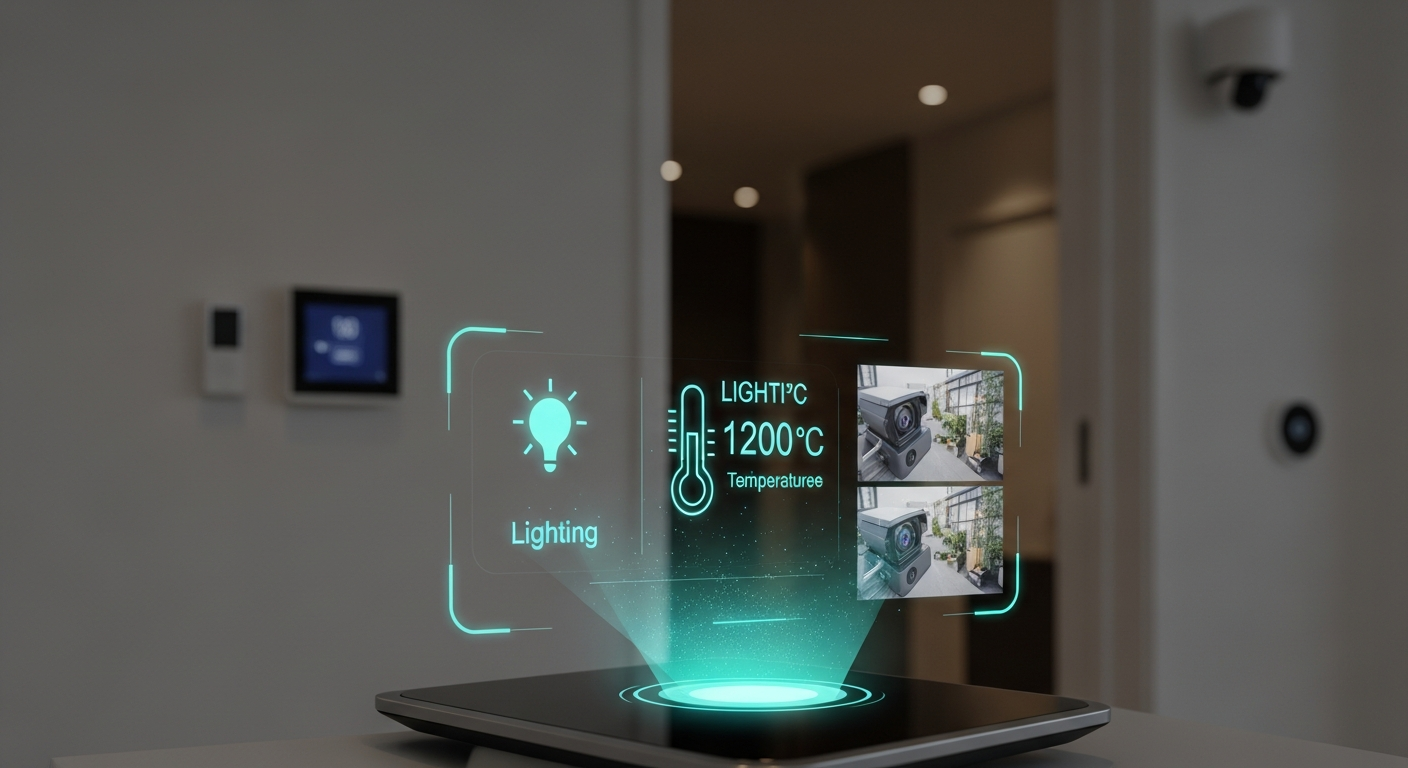
Smart homes powered by AI to control lights, temperature, and security.
- November 20, 2025
- ~ 1 min read
- 137 views
- Everyday AI , Lifestyle & AI , AI Security
Introduction to AI-Powered Smart Homes
Imagine a home that anticipates your needs before you even voice them. A home where the lights dim to your preferred evening ambiance as you settle onto the couch, the thermostat adjusts precisely to your comfort zone the moment you arrive, and security systems not only detect threats but learn to differentiate between a family member and an intruder. This isn't a scene from a futuristic movie; it's the dawning reality of intelligent living, powered by Artificial Intelligence.
For years, the concept of a "smart home" has revolved around convenience – connecting devices like lights, locks, and thermostats to be controlled remotely via apps or voice commands. While certainly a step forward, this represented a foundational phase. The true home automation evolution is now underway, ushering in the era of AI-powered homes. Here, AI isn't just an add-on; it's the brain, transforming a collection of connected devices into a cohesive, adaptive, and truly intelligent environment. Unlike basic automation, which follows pre-set rules, an AI-powered smart home learns from your habits, preferences, and even external factors like weather, making decisions proactively and adapting dynamically.
The integration of AI marks the next exciting frontier for home technology. It moves us beyond simple commands to a system that understands context, predicts requirements, and optimizes various aspects of your daily life without constant intervention. This results in unprecedented levels of convenience, significant gains in energy efficiency, and a robust enhancement to your home's security. This transformation is about creating a home that feels like a living, breathing ecosystem, constantly working to improve your comfort and peace of mind.
In this article, we'll dive deep into how cutting-edge smart home AI is revolutionizing three critical areas: lighting, temperature control, and security systems. We'll explore the sophisticated ways AI manages these functions, offering insights into the tangible benefits and what the future of smart homes truly holds. Prepare to discover how your home can become not just smart, but truly intelligent.
The Core Mechanics: How AI Controls Your Home
At the heart of every truly intelligent smart home lies a sophisticated interplay of Artificial Intelligence. Moving beyond simple programmed rules, AI brings a dynamic, learning capability that transforms a collection of devices into a cohesive, responsive ecosystem. Understanding the 'how' reveals the magic behind its proactive intelligence.
The Foundations: AI, Sensors, and Data Fusion
The journey begins with **sensor data**. Your smart home is equipped with an array of sensors – motion detectors, ambient light sensors, temperature and humidity probes, door/window contacts, and even sound sensors. These devices constantly gather real-time information about your home's environment and occupancy. This raw data is then fed into the central AI system, which acts as the brain.
Here's where **AI machine learning home** capabilities truly shine. Instead of relying on static "if-this-then-that" commands, machine learning algorithms process this continuous stream of data to identify patterns, learn your family’s habits, and understand the nuances of your living space. For instance, it learns peak occupancy times, preferred light levels, and even how quickly your home heats or cools. This analytical power allows the AI to make autonomous decisions, predicting needs and adjusting systems proactively, rather than merely reacting to immediate triggers. This is the paradigm shift from basic automation to genuine intelligent automation.
Intelligent Optimization: Lighting and Temperature Control
Imagine lighting that anticipates your needs, or a climate system that maintains perfect comfort without a second thought. AI makes this possible. For lighting, **adaptive lighting** systems leverage AI to learn your preferences for brightness, color temperature, and even when and where lights should be on. By integrating data from natural light sensors and your historical usage patterns, AI can dim or brighten lights throughout the day, ensuring optimal illumination while conserving energy. If it's a sunny afternoon, the AI knows to rely more on natural light; if you typically work in a specific room at night, it ensures that area is adequately lit.
Similarly, a **smart thermostat AI** uses advanced machine learning to provide unparalleled climate control. This goes beyond simple scheduling. Through **predictive control**, the AI considers various factors: real-time weather forecasts, your home's insulation properties, current occupancy, and learned preferences. It can pre-heat or pre-cool your home before you arrive, or adjust temperatures in different zones based on who is present, ensuring maximum comfort and energy efficiency. The system learns how long it takes to reach a desired temperature, minimizing wasted energy and ensuring you're always comfortable.
Enhanced Safeguards: AI Security Systems
When it comes to security, AI transforms reactive monitoring into proactive protection. Modern **AI security systems** utilize sophisticated algorithms for **anomaly detection**. This means the system can distinguish between routine activities (like a pet moving through the house) and genuinely unusual or suspicious events (like an unexpected intruder). By analyzing patterns from motion sensors, cameras, and access points, AI can flag deviations from the norm and alert you instantly.
Beyond simple alerts, AI powers features like advanced facial recognition for authorized entry, reducing false alarms and enhancing convenience. It can even learn the sounds of your home, alerting you to a smoke alarm or breaking glass when you're away. By constantly learning and adapting, AI provides **predictive alerts**, often identifying potential security breaches or threats before they fully materialize, offering a new level of peace of mind for your home and family.
Real-World Impact: Use Cases for AI-Driven Comfort and Safety
The promise of a smart home often conjures images of effortless living and enhanced security. With Artificial Intelligence at its core, these visions are not just futuristic concepts but present-day realities transforming daily life. AI doesn't just automate; it anticipates, learns, and adapts, delivering unparalleled convenience, efficiency, and peace of mind. Let's explore some compelling smart home use cases that highlight AI's profound impact.
Effortless Mornings: AI-Adjusted Comfort
Imagine waking up not to a jarring alarm, but to a gentle, personalized awakening. Your AI-powered smart home learns your sleep patterns and morning preferences. As your alarm time approaches, integrated smart blinds slowly open, allowing natural light to filter in. Simultaneously, the thermostat subtly raises the temperature to your ideal level, and the coffee maker begins brewing. This isn't just a timed sequence; it's an intelligent response. If the weather forecast predicts an unusually cold morning, your system might preemptively start heating earlier, ensuring consistent comfort. These sophisticated automated routines remove the guesswork from your start to the day, ensuring you always wake up on the right side of the bed, feeling refreshed and ready.
Dynamic Optimization: Smarter Energy Management
One of the most tangible benefits of AI in smart homes is its ability to revolutionize energy consumption. Beyond simple scheduling, AI systems continuously analyze factors like occupancy, external weather conditions, time of day, and even electricity pricing. For instance, if you leave a room, AI-powered sensors detect the absence and automatically adjust lighting and temperature, ensuring no energy is wasted. Conversely, if your commute home is delayed, the system can postpone pre-heating or cooling until you're closer, optimizing resources. This form of predictive home management means your home isn't just reacting to commands; it's proactively minimizing your carbon footprint and significantly reducing utility bills. This intelligent approach to resource allocation is where energy efficiency AI truly shines.
Proactive Protection: Intelligent Security Scenarios
Security goes beyond mere cameras and alarms when AI steps in. AI-driven security systems can differentiate between a pet moving across the living room and an actual intruder attempting to access your property. Utilizing advanced facial recognition and behavioral analytics, the system can identify unfamiliar individuals, vehicles, or unusual activities around your perimeter. Instead of generic motion alerts, you receive specific notifications detailing the threat, often with accompanying video footage. In a true smart security scenario, if an intruder is detected, the system can trigger a multi-layered response: lights flash, an alarm blares, and a notification is sent directly to you and, if configured, to local authorities. This proactive, intelligent approach provides unparalleled peace of mind, knowing your home is under vigilant, discerning surveillance.
Case Study: The Millers' Integrated AI Lifestyle
The Miller family in Seattle embraced a fully integrated AI smart home system last year, and their lives have been transformed. "It's like having a silent, incredibly efficient assistant," Mrs. Miller shares. Their mornings are seamless, with AI ensuring optimal temperature and lighting that adapts even if daylight saving time shifts. During the day, with both parents at work and children at school, the home intelligently conserves energy, adjusting climate control and turning off unnecessary lights. When a package is delivered, the AI system verifies the delivery driver, securely unlocks the delivery closet, and relocks it, sending a notification to Mr. Miller's phone. Evenings bring an automatic shift to a cozy ambiance with dimmed lights and preferred music playing as they enter. The Millers attest that their AI home has not only enhanced their comfort and safety but has also led to a noticeable reduction in their energy bills, embodying the ultimate AI home comfort and convenience.
Under the Hood: Advanced AI Concepts in Smart Home Technology
While the surface-level benefits of AI-powered smart homes are clear – enhanced comfort, energy savings, and robust security – a deeper dive reveals the sophisticated engineering and conceptual frameworks that make these systems tick. This section caters to the technically curious, peeling back the layers to explore the advanced AI concepts underpinning the next generation of home automation.
The Intelligence Divide: Edge vs. Cloud AI
One of the foundational distinctions in modern AI infrastructure lies in where the intelligence processing occurs. In the smart home context, we primarily talk about edge AI smart home systems versus cloud AI systems.
- Edge AI: This refers to AI processing that happens directly on the device itself (the "edge" of the network), rather than sending data to a remote server. Think of a smart camera that analyzes footage for motion or facial recognition without uploading every frame, or a voice assistant that processes simple commands locally. The key advantages are speed (lower latency), reduced bandwidth usage, and significantly enhanced data privacy, as sensitive information often never leaves your home network. This localized processing makes systems more responsive and resilient, even during internet outages.
- Cloud AI: Conversely, cloud AI leverages the immense computational power of remote data centers. When your smart thermostat sends data to the cloud for long-term pattern analysis, or your voice assistant processes complex natural language queries that require vast datasets, that's cloud AI at work. Its benefits include access to vast learning models, the ability to learn from aggregated data across millions of users, and easier over-the-air updates for new features. However, it relies on a stable internet connection and raises more questions about data transmission and storage security.
Most cutting-edge smart homes employ a hybrid approach, strategically using edge AI for immediate, privacy-sensitive tasks and cloud AI for complex analytics, learning, and cross-device synchronization. This balanced architecture optimizes both performance and privacy.
Weaving the Digital Tapestry: Interoperability and Security Foundations
A truly intelligent home isn't just about individual smart gadgets; it's about how they communicate and work together seamlessly. This brings us to the critical challenges of smart home interoperability and the paramount importance of security.
- Interoperability Challenges and Universal Protocols: Historically, connecting devices from different manufacturers has been a frustrating maze of incompatible ecosystems. This fragmentation hinders comprehensive AI control. Enter universal protocols like Zigbee and Z-Wave, which establish mesh networks for reliable, low-power communication among devices. More recently, Matter has emerged as a game-changer. Backed by major tech giants, Matter aims to be a unifying standard, abstracting away underlying network technologies (Wi-Fi, Thread, Ethernet) to ensure that compatible devices can "talk" to each other out-of-the-box, regardless of brand. This simplifies setup and paves the way for more sophisticated, integrated AI algorithms to orchestrate entire home environments.
- Data Privacy Smart Home & IoT Security: The more connected our homes become, the larger the digital footprint and the greater the potential for vulnerabilities. Robust security is non-negotiable. This involves multi-layered approaches:
- Encryption: Ensuring all data, whether in transit to the cloud or stored on local devices, is strongly encrypted.
- Authentication: Implementing strong authentication protocols, including multi-factor authentication (MFA), to prevent unauthorized access.
- Regular Updates: Manufacturers must provide consistent software and firmware updates to patch vulnerabilities as they are discovered, a critical aspect of IoT security.
- User Control: Empowering users with granular control over data sharing settings and privacy preferences. Understanding which data is collected, how it's used, and who has access to it is fundamental for trust.
Beyond Automation: Predictive Intelligence and Ethical Dimensions
The true power of AI in the smart home extends beyond reactive automation, moving towards predictive intelligence and, importantly, requiring careful ethical consideration.
- Advanced Analytics and Predictive Algorithms: AI's ability to learn from vast amounts of historical data is transformative. Your smart thermostat doesn't just adjust to your presence; it learns your thermal preferences over weeks, considering external weather data to pre-cool or pre-heat your home for optimal comfort and energy efficiency. Security systems use predictive algorithms to identify anomalous patterns – a sudden increase in energy usage when no one is home, or a door sensor activated at an unusual time – flagging potential issues before they escalate. These AI algorithms move smart homes from reactive to proactive, anticipating needs and mitigating risks. Future developments will see AI predicting appliance failures, optimizing energy grids based on household demand, and even personalizing health and wellness routines.
- Ethical AI in Home Technology: As AI gains more autonomy in our personal spaces, ethical considerations become paramount.
- Bias: AI models are only as unbiased as the data they're trained on. If training data doesn't represent diverse users, the AI might perform poorly or unequally for certain demographics (e.g., voice assistants struggling with specific accents, facial recognition systems having higher error rates for certain skin tones). Developing ethical AI requires meticulous attention to data diversity and ongoing auditing.
- Control and Autonomy: Who is in control – human or machine? Smart homes must always provide clear override mechanisms and transparent explanations for AI decisions. Users must feel empowered, not subjugated, by their technology.
- Transparency and Accountability: Understanding why an AI made a certain decision is crucial. If a security system mistakenly alerts authorities, who is accountable? As AI systems become more complex, transparency in their decision-making processes and clear lines of accountability are essential for trust and responsible deployment.
Navigating these ethical waters will define the future of AI's integration into our homes, ensuring technology serves humanity in a way that is fair, secure, and empowering.
Building Your Intelligent Abode: Implementation and Best Practices
1. Planning Your AI Smart Home: Needs, Budget, and Scalability
Before diving into smart home installation, assess your needs and long-term goals. Start by identifying which areas—lighting, temperature, or security—require automation. Consider lifestyle factors like family size, daily routines, and energy consumption patterns. For example, frequent travelers might prioritize security systems with real-time alerts, while eco-conscious homeowners may focus on energy-efficient climate control.
- Define priorities: List must-have features (e.g., voice-controlled lights, automated thermostats) versus nice-to-have add-ons.
- Set a budget: Include upfront costs (devices, hubs) and recurring expenses (subscription services, energy savings).
- Future-proofing: Choose a system with expandable capabilities to accommodate new AI-powered devices.
2. Selecting the Right AI Hub and Compatible Devices
The AI hub selection is critical for seamless integration. Popular options like Google Home, Amazon Alexa, and Apple HomeKit offer distinct ecosystems. Google and Alexa excel in third-party compatibility, while HomeKit prioritizes privacy and security. For DIY smart home AI projects, ensure all devices share a common protocol (e.g., Zigbee, Z-Wave) to avoid interoperability issues.
Tip: Always verify device compatibility with your chosen hub before purchasing. A fragmented ecosystem can lead to inefficiencies and user frustration.
3. Step-by-Step Setup and Optimization
- Install the hub: Place your AI hub centrally for optimal Wi-Fi coverage and device connectivity.
- Integrate devices: Use the hub’s app to add smart lights, thermostats, and security cameras. Follow the smart home setup guide provided by the manufacturer.
- Configure routines: Set up automation rules (e.g., “Good Morning” routine to adjust temperature and turn on lights at sunrise).
- Test and refine: Observe AI behavior over days/weeks, adjusting preferences for accuracy and efficiency.
4. Avoiding Pitfalls and Ensuring Long-Term Success
Common mistakes include overloading your network with incompatible devices or neglecting security updates. To sidestep these issues:
- Stick to one ecosystem: Mixing hubs (e.g., Alexa and HomeKit) often complicates management.
- Update regularly: Enable automatic firmware updates to patch vulnerabilities and improve AI performance.
- Optimize Wi-Fi: Use mesh networks or extenders for stable connectivity, especially in large homes.
Smart home best practices also include documenting your setup and creating backup plans for power outages. By following these steps, you’ll build a secure, efficient, and future-ready intelligent abode.
AI vs. Traditional Smart Homes: A Comparative Analysis
As smart home technology continues its rapid evolution, a crucial distinction has emerged between traditional, rule-based systems and the cutting-edge capabilities offered by Artificial Intelligence. Understanding this fundamental difference is key to making an informed decision about your home automation journey. This section provides a comprehensive home automation comparison, delving into the nuances of each approach.
The Fundamental Shift: Reactive Rules vs. Proactive Intelligence
The core difference between a conventional smart home and one powered by AI lies in their operational philosophy: reactivity versus proactivity. Traditional smart homes operate on an "if this, then that" logic. You set specific rules: "If the time is 7 PM, turn on the living room lights" or "If the front door opens, disarm the security system." While effective for basic automation, this approach is inherently reactive and lacks flexibility. It performs tasks based on predefined conditions but doesn't learn or adapt to changing circumstances.
In stark contrast, AI-powered smart homes exhibit proactive control. These systems leverage machine learning algorithms to analyze patterns of behavior, environmental data, and user preferences over time. For instance, an AI-driven lighting system doesn't just turn on lights at 7 PM; it learns when you typically arrive home, adjusts brightness based on natural light levels, your mood, and even anticipates your needs. Similarly, an AI thermostat won't just follow a schedule; it learns your thermal comfort zones throughout the day, accounts for external weather changes, and adjusts proactively to maintain optimal conditions, leading to superior energy efficiency comparison outcomes. This adaptive learning is what makes AI systems feel significantly more intuitive and personalized.
Enhanced Security and AI's Adaptive Advantage
When it comes to security, the distinction between traditional and AI smart homes becomes even more pronounced. Traditional security systems often rely on motion sensors, door/window contacts, and cameras that trigger alarms based on simple detection. While effective, they are prone to false alarms – a pet triggering a motion sensor or a branch swaying in front of a camera. This can lead to alarm fatigue and a diminished sense of security.
AI-driven security systems, however, utilize advanced computer vision and machine learning to differentiate between threats. An AI camera can distinguish between a squirrel, a delivery person, and an unknown intruder. It can learn familiar faces and vehicles, notifying you only of genuinely suspicious activity. AI can analyze behavior patterns – for example, prolonged loitering near a property – and trigger alerts before an incident even occurs. This sophisticated analysis not only reduces false alarms but also provides a more robust and reliable protective layer for your home, allowing for a more accurate and meaningful AI vs smart home security assessment.
Weighing the Investment: Pros, Cons, and Platform Choices
Adopting an AI-powered smart home offers undeniable benefits but also comes with specific considerations. Let's explore the smart home pros cons of these advanced systems:
Pros of AI-Powered Smart Homes:
- Unrivaled Convenience: Truly autonomous operation that anticipates your needs.
- Optimized Efficiency: Superior energy savings through predictive heating, cooling, and lighting.
- Enhanced Security: Intelligent threat detection and significantly reduced false alarms.
- Personalized Experience: Systems that adapt and learn your preferences over time.
- Seamless Integration: Often capable of more complex and adaptive learning across diverse devices.
Cons of AI-Powered Smart Homes:
- Higher Initial Cost: AI-capable hardware and software typically demand a larger upfront investment.
- Complexity and Setup: May require more technical understanding during initial setup and calibration.
- Privacy Concerns: Reliance on data collection and cloud processing raises questions for some users.
- Learning Curve: While intuitive, it takes time for the AI to learn your patterns effectively.
When evaluating different AI smart home platforms, you'll encounter major players like Google Home/Assistant, Amazon Alexa, and Apple HomeKit. Each offers a unique ecosystem with varying degrees of AI integration. Google Assistant, for instance, excels in natural language understanding and proactive suggestions based on your calendar and location. Alexa boasts a vast array of compatible devices and strong voice control capabilities. Apple HomeKit offers robust privacy features and deep integration with the Apple ecosystem. The best choice often depends on your existing devices, preferred digital assistant, and commitment to a particular brand's ecosystem. Look for platforms that offer seamless integration with a wide range of devices and robust privacy controls that align with your comfort level. Understanding these trade-offs will empower you to choose a system that delivers the convenience and security you desire while fitting your budget and technical comfort zone.
The Future is Now: Embracing Your Intelligent Home
Recapping the Revolution: AI at Your Command
As we conclude our exploration into the remarkable world of AI-powered smart homes, it's clear that Artificial Intelligence isn't just a buzzword – it's the invisible architect reshaping our living spaces. We've seen how AI effortlessly orchestrates complex systems, from autonomously adjusting your lighting for optimal ambiance and energy conservation, to precisely regulating your indoor climate for peak comfort and efficiency. Crucially, AI also fortifies your sanctuary with advanced, proactive security measures, offering peace of mind like never before. The AI home benefits are profound and transformative: unparalleled convenience, enhanced security, and significant energy efficiency. No longer are smart homes about isolated gadgets, but an interconnected ecosystem where every device works in harmony, powered by intelligent algorithms designed to simplify and elevate your life.
Beyond Today: The Evolving Landscape of Intelligent Living
The journey of intelligent living, however, is far from over. Looking ahead, the future of smart homes promises even more profound integration and personalization. We can anticipate increasingly intuitive interfaces, where voice commands and gestures give way to predictive actions based on learned habits and even emotional cues. Hyper-personalized environments will adapt to our unique routines and preferences with uncanny accuracy, anticipating our needs before we even articulate them. Emerging smart home trends point towards truly ubiquitous computing, where technology fades into the background, making interactions feel natural and effortless. Imagine a home that not only knows your preferences but also understands your mood, adjusting everything from lighting color to background music to create the perfect atmosphere without any input from you. This level of seamless integration will redefine comfort and convenience.
Your Next Step Towards a Smarter Tomorrow
In intelligent living conclusion, the evolution of smart homes powered by AI marks a pivotal moment in how we experience our personal sanctuaries. It’s an invitation to step into a future where your home actively contributes to your well-being, efficiency, and peace of mind. This isn't just about technology; it's about reclaiming time, reducing stress, and enhancing your quality of life. We encourage you to explore the myriad of AI-powered smart home solutions available today. Whether you start with an intelligent thermostat, integrate smart lighting, or invest in an advanced AI-driven security system, embracing AI in your home is a powerful step towards a more comfortable, secure, and energy-efficient life. Don't just observe the future; become a part of it. Discover how AI can transform your everyday, making your home not just smarter, but truly alive and responsive to your every need.

Comments (0)
Please login or register to leave a comment.
No comments yet. Be the first to comment!